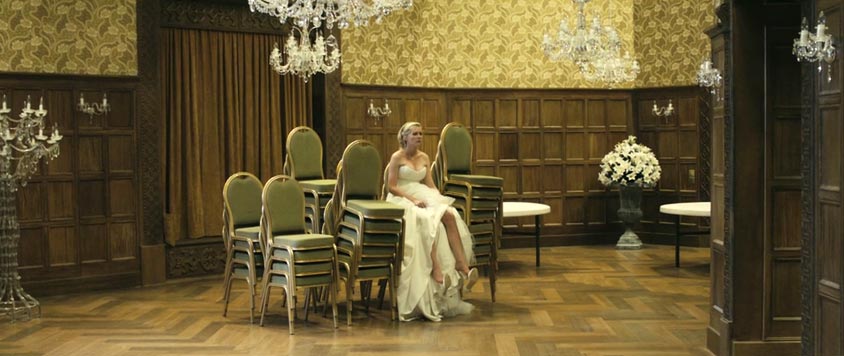
Showing posts with label Swedish Cinema. Show all posts

Tuesday, September 11, 2018

The Sacrifice (1986) A Film by Andrei Tarkovsky


"In Andrei Tarkovsky’s The Sacrifice, the distance from hope to despair is a short jump—a chasm crossed with the help of something so immediate as a television transmission. As his birthday celebration winds down on a gloomy summer evening in remote Sweden, retired intellectual Alexander (Erland Josephson) tiptoes half-drunk into his living room to find a small company of friends and family bewitched by the soft blue glow of a TV set’s screen, out of which emanates an announcement of nuclear conflict. The warning winds down, the TV is turned off, and the mood descends—first into stunned silence, then into outright hysteria, and then into a kind of sedated anxiousness from which the film never quite resurfaces. In certain contexts, this dramaturgical pivot might register a bit maudlin, but in 2018, when Twitter and cable news provide an endless gushing stream of outrages, the film’s evocation of being rapidly thrown into disarray by a piece of topical turmoil hits home."

Kino released a new Blu-ray for The Sacrifice, so I reviewed it for Slant.

Friday, November 3, 2017

The Square (2017) A Film by Ruben Östlund


"After scrupulously analyzing the rippling effects of a man’s moment of human weakness in Force Majeure, Ruben Östlund has adopted a more panoramic view for The Square, edging his latest film closer to the vignette-driven narrative terrain of 2008’s Involuntary. Juggling the handful of interconnected tribulations that overwhelm Christian (Claes Bang), the curator of a reputable Stockholm contemporary art museum, in the run-up to the opening of a new relational art exhibition called The Square, the film grabs at a pinwheel of hot-button social topics including class privilege, liberal guilt, urban poverty, viral marketing, and mutually reinforced passivity in the face of mounting inhumanity, winding up with something simultaneously overstuffed and undercooked. While Östlund’s mastery of visually amplifying social unease is still very much intact, he’s partially undone here by his own thematic ambition, which, in scene after exquisitely staged scene, threatens to put too fine a point on otherwise thrillingly indeterminate situational comedy."

My review of Ruben Östlund's very disappointing Palme D'Or winner and NYFF selection continues at Slant.

Monday, April 17, 2017

The Happiest Day in the Life of Olli Mäki (2016) A Film by Juho Kuosmanen


"With its 16mm black-and-white cinematography and lack of musical score, however, The Happiest Day in the Life of Olli Mäki reaches further back into history for its primary cinematic touchstones, specifically to the grayscale neorealism of Ermanno Olmi and the Czech New Wave films, works which unhurriedly examined the plights of working-class everymen jostled around by forces of class and economics. It's noted often in the dialogue that Mäki's humble background is as a baker, and Elis repeatedly reminds him of the pitiful 'backwoods' to which he will return if he fails to live up to the hype. Alas, Kuosmanen places his sympathies squarely with the rube who's hopelessly out of place in a globalized market."

Review continues at Slant Magazine.

Tuesday, February 9, 2016

The Emigrants / The New Lands (1971 / 1972) Films by Jan Troell


"'We're the best of friends.' That's the endearment that a married couple, played by Max von Sydow and Liv Ullmann, whisper to one another in Jan Troell's The Emigrant. For anyone familiar with von Sydow and Ullmann's collaborations in the filmography of Ingmar Bergman, it's a deeply moving moment as much for its narrative context—Ullmann's character is suffering from seasickness aboard a ship to America as a storm beats against her cabin and fellow peasants wail outside the frame—as for its metatextual implications. The two actors sparred, trembled, and agonized together on screen so routinely under the gaze of the famously penetrating Swede that a comparatively blissful moment almost registers as a glitch, even as it doubles as a validation of the pair's fruitful working relationship. It's hard to imagine any fan emerging from the scene, sensitively prolonged by Troell in intimate close-ups, with dry eyes." Review of an excellent new Criterion Collection disc continues at Slant.

Friday, October 24, 2014

Force Majeure (2014) A Film by Ruben Östlund


"The largely frosty Force Majeure is repeatedly thawed by a sense of humor that suggests Fellini on downers—reined-in burlesque, in other words—and a philosophical interest in the role of chance, so powerful a force in life as to upset even the film’s own controlled surface (as it does in a sublimely amusing moment that fleetingly assumes the point of view of a remote-controlled flying toy at the most inopportune time). Despite the film’s overarching Scandinavian austerity—Östlund’s shots rarely move for fear of displacing the careful merging of compositional lines with the corners of the 2:35:1 frame—it’s also cinematographically in tune with its characters at pivotal moments in ways that suggest a sharp directorial sensitivity." Full piece on this Scandinavian stroke of brilliance at In Review Online.

Thursday, December 12, 2013

Liv & Ingmar (2012) A Film by Dheeraj Akolkar

You don't need to look much further than its cornball poster art to get an idea of what kind of film Dheeraj Akolkar's Liv & Ingmar is. In honor of Liv Ullmann's 75th birthday, NYC's Film Society of Lincoln Center is holding a week-long celebration of the actress' collaborations with Ingmar Bergman, and the brief retrospective kicks off with this documentary, a rather disproportionately gushy opening act to a series of bleak, intense dramas. My full thoughts, for In Review Online, can be read here.

Tuesday, August 14, 2012

Scenes from a Marriage (Episodes 4, 5, and 6) A TV Series by Ingmar Bergman (1973)

The sense of finality that looms over Paula, the third episode of Ingmar Bergman's Scenes from a Marriage, made it seem as if there was nowhere else the series could go. Johan and Marianne (Erland Josephson and Liv Ullmann), the content lovers of the first two episodes, wound up in a split that would last an indeterminate amount of time, and the sheer cruelty and tactlessness with which Johan revealed his infidelity left no hint that a reunion would come any time soon. Vale of Tears, the fourth episode of the series, leaps ahead about eight months from the emotional explosion of Paula to depict the first meeting of the still-legally-bound couple in the suburban home where Marianne and her two daughters continue to live. The occasion would seem ripe for bitterness and hostility, but instead the evening begins in rather unexpected fashion. When they first see each other at the front door of their home, Bergman reveals the moment by observing Marianne's reaction to it, but she is not uneasy or cold. Instead, she approaches the door like a girl about to see her prom date - that is, with a sense of anticipation and surefooted confidence. There is no villainous POV close-up of Johan, only an unassuming profile view as he enters the tight frame from the left, smiling gently at the sight of his well-dressed wife. This is the key to Bergman's non-judgmental outlook here, which recognizes evil and unfairness but always allows for time to smooth over rough patches, if not entirely wipe them away.

Obligatory catching up and hesitant stabs at intimacy dominate much of the action that opens Vale of Tears, but slowly Bergman peels back the unruffled surface to reveal layers of regret, disappointment, and anger. Johan is quick to mention how he has become tired of Paula's mood shifts and pettiness, and also makes an offhand comment about how Marianne turns him on, but his affection feels impermanent. Marianne teasingly resists Johan's kisses and modest sexual advances, mentioning her own casual romantic affairs in the process. They sit down for tea and dinner, and both of them seem acutely aware of the dangerous dance they are involved in, as well as the sense that they are cycling through old routines in a new light. After dinner, the two sit down on the couch (throughout Scenes from a Marriage, a couch is used as a transitional device between small talk and sexual flirtation or intimate conversation), continuing to liquor themselves up and geting closer and closer to acknowledging the elephant in the room. Marianne, sensing her self-confidence waning, deflects the pressure from Johan by reading an entry in her diary that she wrote during their break from each other.

Essentially a reflection on her own identity at this cross-section of her life, the diary entry is extremely confessional, putting her struggles with Johan in the context of her often tumultuous upbringing. Bergman visualizes the scene by pairing Ullmann's words with archival photographs of the actress throughout her life. It's one of the most poignant scenes of the entire series, subtly self-reflexive in the way it draws attention to the longtime collaboration between Bergman and his primary muse, whom he used at various points in his career to reflect different sacred relationships in his life (his mother, his lover, his wife, etc.) Also, it's a very significant scene in the progression of both the episode and the entire series, seeing as it marks a shift in Marianne from a confused victim of Johan's erratic behavior to a women capable of detached self-analysis. Early in Vale of Tears, Johan gives a typically Bergmanesque monologue about loneliness being the default mode of existence, the only way to truly feel secure, but Marianne offers an indirect rebuttal by suggesting that security comes from a feeling of self-respect and self-understanding, which help to stave off loneliness. When she finishes reading the entry, she realizes that Johan has actually fallen asleep and missed much of her speech, proving not only that he's characteristically self-involved but also that his presence and attention is inessential to her stability as an individual. But, as is par for the course in Scenes from a Marriage, temptation and memory flows back into consciousness, and the episode concludes with a prolonged, uncertain progression into bed for the couple, a passionate but transient attempt at sex, and Johan's grumpy departure in the middle of the night.


Bergman's own sympathies seem to jockey back and forth throughout Scenes from a Marriage nearly as often as Johan and Marianne's power roles reverse during conversation. There are moments when Johan's cynicism and despair sound as if they were spoken right from the mouth of the director (and given Bergman's own turbulent marital history, some of his declarations are especially ominous), and other times when he uses Ullmann as an instrument to openly reject Johan's worldview and project a belief in trust and love. Other times the drama onscreen is so alive and free of ideological positions that Bergman seems unsure of who to get behind, and the next episode of the series, The Illiterates, is an example of such an entanglement. Taking place entirely within Johan's nondescript, under-furnished office space, the episode depicts, at least on the surface, the couple's signing of their divorce papers, but a seemingly simple task leads to a harrowing exposé of the trials and tribulations of their marriage, as well as their current feelings towards one another. While the visual style of the episode is particularly bland, even pedestrian (flat lighting and predictable shot-reverse-shot structures), the emotional content is riveting and complex.

Over the course of the episode, Marianne progresses from a cheerful mood to lustful excitement, sudden apathy, mounting irritation, an outburst of repressed exasperation, a return to tenderness, and finally utter exhaustion and pain; Johan, on the other hand, moves from apathy through longing, confusion, depression, narcissism, hatefulness, irritation, and ultimately violent rage. It's a roller coaster showcase - aided by a perpetually dwindling brandy bottle - of all the buried emotions brewing within the first four episodes, the full realization of the totality of Johan and Marianne's relationship. Ever the master of organically butting up contrasting mental states against one another, Bergman presents one of his most exhaustive studies of explosive human behavior in a 50-minute stretch of dialogue that hardly ever pauses until the final beat. Within this time-frame, there is Scenes from a Marriage's most sensuous moment (an unbroken two-shot of Johan and Marianne making love on the office floor with the giddiness of two teenagers finally afforded a moment alone) and its ugliest (Johan hitting and kicking his wife until she's bleeding and defenseless), and Josephson and Ullmann's rigorous performances naturally connect the two extremes. Miraculously, the episode concludes with a sense of hope just barely intact, even as the couple admits defeat and silently signs the divorce forms in the final shot; a clear horror runs through Johan's eyes after his act of brutality, realizing he has done something unimaginable to a person he obviously still loves.


Following this vitriolic emptying of emotions, Scenes from a Marriage offers an exquisite settling of the tides in its next and final episode, In the Middle of the Night in a Dark House Somewhere in the World, which ultimately finds Josephson and Ullmann in precisely the situation its title pronounces. The episode marks a departure from the claustrophobic soul-baring of Paula, Vale of Tears, and The Illiterates and a return to the quotidian casualness of the first two episodes, only a newfound sense of wisdom and honesty has been infused into the relationship. Before Johan and Marianne are seen together though, Bergman opens the episode with two separate scenes of them going about their newly independent lives. In the first, Marianne makes a brief visit to the home of her mother (Wenche Foss) - who up until this point has only been spoken of, and quite frequently - to ask her some questions about her marriage to Marianne's father. She admits to having felt qualms about marrying in the first place given some dormant feelings towards another man, and her confession is perhaps what sparks Marianne's own admission to Johan later that she cheated on him briefly early in their marriage (a remark that is insignificant alongside Johan's own behavior in the series). Bergman also shows Johan in his office dispassionately fielding jealousy from Eva (Gunnel Lindblom), who also appeared in The Art of Sweeping Under The Rug criticizing Johan's private poetry. It was never clear until now that they were sexually involved, adding another, retrospectively trivial, ripple to Johan's infidelity.

When Johan and Marianne do meet up, we discover that it is seven years since their last meeting (presumably the fanfare of The Illiterates) and exactly 10 years after Innocence and Panic, making it their would-be 20th anniversary. Now split up and involved with their own respective spouses (both seem about as forebodingly "content" in their marriage as they did with each other at the beginning of Scenes from a Marriage), the two of them get together to spend an evening at their summer cottage, where Marianne still spends time with her children and Johan hasn't visited since Paula. Yet again, Bergman stirs up a hint of drama around their initial meeting, shooting from across a busy roundabout as Johan approaches his ex-wife. They stop suddenly behind a tree, and there's an abrupt air of mystery regarding whether they are embracing each other in excitement or going through an uncomfortable greeting. When they emerge moments later in a jovial dash towards the car, it plays like Bergman's subtle declaration that all pettiness and bile have escaped from their relationship, leaving only a mutual sigh of acknowledgement that the past is officially past.


This attitude is compounded when after only five to ten minutes in the cottage they decide they cannot spend their evening amidst so many troubling memories so they end up going to Johan's friend's Fredrik's cottage instead. Johan and Marianne's method is not to ignore the past but to realize that it cannot be altered, and that dwindling upon it only means spoiling the positive feelings still existing in their relationship. When they enter Fredrik's place, a log cabin with a seaside view, they share unspoken laughter about the mess inside, focusing their attention on a clownish paper mache face dangling from the ceiling. Bergman, too, seems peculiarly fascinated by this ornament, staging the subsequent conversation with it sandwiched between Josephson and Ullmann in two (three?) shot and even intercutting a tight close-up of the face in the midst of their dialogue. It suggests a mask, a representation of larger-than-life emotional characteristics now extinguished from the couple's interactions. The conversation in In the Middle of the Night is level-headed and honest, yet it does not lack the power of the dialogue in the rest of the series; instead, is charged with a different kind of energy, a depth and richness only capable of being achieved after the kind of feral outbursts in the previous episodes. The final scene, with Johan and Marianne embracing in refreshingly immediate affection, ignoring time and the vagaries of their condition, is one of the most moving in Bergman's entire body of work.

It takes a lot, of course, to get there, and Scenes from a Marriage is rarely an easy ride, both in terms of the uncomfortable level of intimacy on display and the utter refusal on Bergman's part to lend the miniseries any kind of aesthetic flair. But there's a certain level of focus here - a desire to eschew extraneous shots, settings, and characters (Bergman never shows Paula, Johan's mother, or even the couple's children) - that is astounding and truly respectable. What is left is a series of stark, uncompromising images of Erland Josephson and Liv Ullmann, two of Bergman's most committed performers whose souls had been transparent in the Swedish director's work before, but perhaps never with quite this level of visibility and vulnerability.

See episodes 1, 2, and 3 here.

Friday, August 10, 2012

Scenes from a Marriage (Episodes 1, 2, and 3) A TV Series by Ingmar Bergman (1973)

Scenes from a Marriage marks an interesting crossroads in Ingmar Bergman's career. Directly after the primal abstraction of Cries and Whispers, only five years after the batshit insanity of Hour of the Wolf, and preceding a decade which included an exile in Germany and some of the director's strangest, most scattershot work (a decade that nonetheless culminated in his magnum opus Fanny and Alexander), the six-part miniseries is notable for its disarming simplicity and verisimilitude. If Bergman ever resembled Rohmer and Ozu, it's in Scenes from a Marriage, which candidly presents the domestic life of Johan (Erland Josephson) and Marianne (Liv Ullmann), a seemingly prototypical married couple. Shot largely in his hometown of Fårö Island and surrounded by his regular crew of collaborators during the late 60's and 70's - Sven Nykvist on camera, Lars-Owe Carlberg as Producer, Siv Lundgren as Editor - as well as actors and actresses who were among his closest friends, the series benefits from the sense that Bergman was extremely relaxed and focused while making it. Feeling little need for visual acrobatics, non-linear storytelling maneuvers, or sly metaphors, the series presents life in a direct, unadorned fashion, knowing that human emotion over the course of time is beguiling enough.

The first episode, Innocence and Panic, begins with a wide shot seemingly from the perspective of the television camera that is shooting an interview with Johan and Marianne for an unspecified women's health publication. An interviewer (Anita Wall), eventually revealed to have a past school connection with Marianne, probes the couple about their two children and the history and state of their relationship, for the most part gently skimming the surface but also occasionally veering into unexpectedly private territory (sex life, infidelity, philosophies of love and happiness). Throughout the conversation, the interviewer and her offscreen cameraman periodically ask the couple to freeze in their respective positions for a photograph, ostensibly attempting to catch the lovers in some kind of emblematic pose. It's a fitting introduction to this almost excessively intimate and confessional series, an acknowledgement on Bergman's part of the somewhat voyeuristic nature of the project even in spite of its status, technically speaking, as a fiction. Like the opening of Persona, the scene explicitly calls attention to the apparatus of the cinema and the presence of the camera.

This interview also works to lay bare the exposition so that Bergman can jump right into the thick of the drama without having to find ways to develop a bed of narrative context. In fact, at first glance, the subsequent scene doesn't even situate Johan and Marianne as the focus of attention, instead placing the psychological torment of their friends Peter (Jan Malmsjö) and Katarina (Bibi Andersson) front and center. The two couples have a dinner party that slowly unravels into intoxicated confessions of loathing from Peter and Katarina towards one another, an ugly spectacle revealed in tight, clammy close-ups that the complacent Johan and Marianne merely observe in discomfort. Before they digress into antics though, Peter and Katarina mostly make offhand jabs at what they see as the unnatural perfection of their friends' marriage, which has just reached its tenth year. Bergman delicately implies that the hostility that soon boils over between the two of them leaving Katarina humiliated is not a far cry from normalcy, only an exaggerated expression of the insecurities lurking just beneath the surface that can be prompted by even the slightest misunderstanding.


Innocence and Panic concludes by introducing Johan and Marianne in privacy having an extended conversation about the prospect of another child. Their discussion starts in an image that has been quoted several times in the history of cinema since: a wide two-shot from the end of the bed, composing the evenly spaced couple in the center of the frame below a wide expanse of blank wall, both reading a book underneath a cream-colored comforter. Despite the sterility and symmetry of the shot, there's a certain implicit tension in it. It's a configuration that seems too good to be true, perhaps indicative of an orderliness that masks underlying disorder, and indeed later quotations of the shot have often capitalized, sometimes unsubtly, on this impression. But Bergman's treatment of the scene is more organic and complex than this kind of semantic reading allows. When Marianne reveals that she is pregnant, Johan reacts in a calm, collected manner, tactfully asking her whether or not she plans on having the baby. Johan's lack of bias and his graceful respect for his wife's decision is contrasted by her internal confusion and moral dilemma. The conversation, superficially goal-oriented and simple, stretches on for quite some time, and it eventually becomes clear that Johan's indiscrimination, his inability to actively influence Marianne one way or another, only scrambles her even further.

The tendrils of miscommunication stemming from this piece of expertly crafted dialogue extend an air of unease into the second episode of the series, The Art of Sweeping Under The Rug. The title refers to the final scene of the episode when Johan brings up his declining sexual desire only to follow it up by announcing that he needs to get some sleep, but it might as well be in reference to a great deal of the interactions particularly in the first half of the series, where deeper topics are frequently touched lightly but ultimately brushed aside. It's not that Johan and Marianne are afraid to be honest with each other, or that they are incapable of seeing the darker truths of life, but they are cautious of spoiling the positive aspects of their relationship, and they usually end conversations in a loving embrace as if to cement the essential tenderness of their marriage. Such is the case late in the episode when the couple discusses the idea of taking a vacation for a change and it leads to a contemplation of the negative effects that routine might have on their relationship, but naturally the conversation culminates in love and acceptance, with Marianne declaring "I'm so very fond of you." It's clear that there's a lurking irritation here on Marianne's side, especially given the fact that Johan tried to cancel dinner plans with Marianne's mother earlier in the episode and went on to insist upon sticking to a low-key routine that would allow little time for intimacy.


The title's significance could also be said to be reflected in another scene in Marianne's family law firm when she speaks to a woman (Barbro Hiort af Ornäs) desiring a divorce. As a lawyer, Marianne is obligated to maintain stoicism, but her job's demands can't force her to ignore her strong reaction when the woman describes her loveless marriage. She explains how she and her husband have sustained a modest, content relationship for several years despite their utter absence of passion as well as her indifference to her children, and how she has ceased to get sensual pleasure from the material world. Marianne is shocked not only by the way it shatters her perception of family as the most fulfilling source of happiness in life but also by the fear that such alienation could, or perhaps already has, befell her. The woman presents her situation as a sudden realization of all the time she has spent sweeping her apathy under the rug, so to speak, and it puts into perspective Marianne's own way of dealing with hidden marital issues.

If the first two episodes of Scenes from a Marriage coast along on these kinds of subtle deflections of seriousness, the next episode, Paula, offers a sudden outburst of all the repressed dissatisfaction existing in Johan and Marianne's relationship. Set at the family's summer cottage under a forebodingly grey sky (it's easy to forget the episode is shot in color at all), it concerns Johan's confession that he has fallen in love with another woman (the Paula of the title) and his announcement that he will be leaving Marianne and their children the following morning. Following the steady, if questioning, romance and domestic complacency of the first two chapters, the drastic shift in mood and tone is a daring, ambitious move by Bergman, particularly in light of the show's success up to that point. Doom seems to announce itself from the first shot, an image of Johan driving along the island road at dusk in between two sparse trees and through floating fog. He is greeted by a jovial Marianne who wasn't expecting him this particular night, but it is not long before she detects his somber attitude.


Johan proceeds to explain his decision with cruel honesty, treating his blooming romance with Paula - which he has kept a secret from his wife for months - as an inevitable fact of life that cannot be reversed. His tone of voice is calm for the most part, inflected by the same kind of cerebral detachment that has characterized his diction throughout Scenes from a Marriage, but occasionally he raises his voice and impulsively lashes out against Marianne, which makes him resemble Peter from the first episode. Ullmann plays Marianne's response to the situation with a conflicted mixture of disbelief, anger, and acceptance, and her glazed eyes during the unveiling suggest that each emotion has become indistinguishable from one other. Her shock at the sheer suddenness of Johan's confession is mirrored by the audience's shock at such a radical leap in Johan's attitude, and as a result the entire episode plays like a surreal nightmare, an illusion of a marriage going as horribly as possible. Only a slimmer of hope that it's all a dream could possibly explain Marianne's level-headed reaction to her husband's wickedness, her complete lack of externalized anger and even her willingness to help Johan pack for his trip. But there's nothing dreamy about Bergman's presentation of the sequence; as usual, his camera remains fixed unflinchingly on the faces of his actors, following their every move, unwilling to offer any relief from the inscrutable display of emotions.

In fact, Bergman's approach here is so unadorned that it nearly comes across as uncinematic, which is a common feeling I get while watching Scenes from a Marriage. The series' reliance upon zooms and pans to follow the action often give it the feeling of a stage play shot from the perspective of an audience member. Too frequently, Bergman and Nykvist allow the brilliant acting and the dialogue to do all of the talking instead of discovering dynamic ways to frame and block the conversations, the latter generally being a hallmark of their approach. Nevertheless, there's the occasional stroke of ingenuity - the shot in the second episode that observes as Johan and Marianne enter in and out of rooms in the hallway of their home, capturing with Ozu-like precision the flow of everyday life, the aforementioned bed shot in the first episode, or the overhead shot in episode 3 of the couple in a crying embrace in bed, so tight as if to portray them as one body - that exposes their visual abilities and keeps the miniseries from divulging entirely into the domain of theater. Of course, Bergman was a master of both mediums, but his greatest work tends to obliterate the idea that there's any such thing as a medium at all.

Continue to episodes 4, 5, and 6 here.

Thursday, July 12, 2012

Cries and Whispers (1972) A Film by Ingmar Bergman

There's a chilling image early on in Cries and Whispers that gets to the core of the film, perhaps even to all of Ingmar Bergman's oeuvre. It's a tight close-up of Harriet Andersson's face as she lies in bed. It shows a women in a comfortable setting, with a soft white pillow filling up the edges of the frame. Yet the strange progression of feeling that flows through Andersson's face suggests that the pillow has no power over human emotion. Andersson's playing a dying woman named Agnes, but the film has not yet made the fact or nature of her illness clear when the shot arrives. As it begins, Agnes is just waking up. Her face goes blank for a moment before stretching into an odd contortion. The first hunch is that she's yawning, but that supposed yawn shifts effortlessly into a gape of seemingly horrendous pain, and ultimately resolves itself into another blank facade, this time graced by a hint of a smile. It's a close-up of unorthodox length, and across its long runtime it captures a myriad of powerful emotions co-existing: indifference, relief, pain, sorrow, misery, boredom, catharsis, happiness. Bergman's films have always made it an uncomfortably blunt truth that a psyche cannot possess one of these states without the rest of them. Cries and Whispers seems built entirely around that idea.

An echo of this shot emerges later in the film when Agnes' oldest sister Karin (Ingrid Thulin) reacts to Agnes' younger sister Maria's (Liv Ullmann) frank pronouncements of the distanced state of their relationship. Karin buries her face in her hands, beginning to laugh but also cry, and when her face returns from her hands, the distinction between the two is still not obvious. Cries and Whispers boasts some of Bergman's finest and most respectful direction of actresses, a skill he was able to master throughout his career, but here the performances reach majestic levels of complexity and candidness. Andersson with her gasping, unflinching morbidity, Thulin with her ice-cold hatefulness and detachment, Ullmann with her self-involved vulnerability, and Kari Sylwan (as the maid Anna) with her bruised despair; it's impossible not to think of the film first in terms of its faces, big, bold, and passionate, always dominating the screen. A consistent editorial device is a cut to one of these faces staring directly at the viewer, positioned in front of a black abyss. There's an urgent confrontational quality to it.

Limited to a single setting and utter silence with the exception of dialogue, ambient whispers, the infrequent use of Chopin and Bach, and the occasional impact sound, Cries and Whispers distills Bergman's aesthetic to its simplest form. The film feels very little need to couch its spiritual questioning in narrative forms; it uses the enclosed tomb of a countryside mansion as an arena in which to directly address matters of faith, death, and love. Sure, there's a narrative here - Agnes is slowly dying from cancer and the event of death gradually reveals the ugly truth of the sisters' relationships - but Bergman doesn't treat it as such. Rather, the film is a trance-like parade of the most harrowing of emotions, treated in an almost free-associative manner. In the following order, Bergman shows confrontations with mortality, petty displays of vanity and sexual desire, scorching proclamations of self-hatred and insularity, hallucinatory stages of grief, troubling instances of emotional denial, and, finally, an ambiguous vision of posthumous bliss. Stitched together by the pulse of red transitions and the direct address close-ups, there's a great fluidity to this evolution, a sense of logical emotional development that could never come through on paper.

Bergman opens the film with a characteristically moody introduction, a sequence of images divorced from dramatic context. Shots of the outside of the manor on a foggy morning are framed by Sven Nykvist with unusual compositional dynamics - twice, a fat tree is placed just off center in the frame, seeming to insist upon blocking the view of the yard. As the only exterior shots potentially taking place in the "present" (the rest occur in idyllic recollections by the central characters), it's as if Bergman is establishing the present as something that is unreachable, forever shrouded in mist: these women, in their womb-like mansion (Bergman allows only the faithful Anna a brief view out a window), seem to exist perpetually behind the present tense, so fixated on death and despair that they're constantly leaning backwards, their only source of positivity in the past. These images then bleed into close-ups of ticking clocks, one of Bergman's signature motifs. The insistence upon time further situates the sisters in a march towards death, and the next scene features Karin, Maria, and Anna literally waiting for the death of Agnes in the adjacent room. (In fact, at one point Maria even appears dead in a pose that would recently be echoed by a dead woman in Manoel de Oliveira's The Stange Case of Angelica.) Time moves too fast and too slow simultaneously; Agnes both craves a release from her imprisoning pain and fondly recalls instances of pleasure that make the fear of doom palpable.

The figure of Anna offers the only respite for Agnes' consuming misery. Anna's treated with a lack of respect by Karin and Maria, and especially by Karin's malevolent husband Fredrik (Georg Årlin), who later tries to lay off Anna without so much as a thank you for her long-term work, but she retains a core of dignity against all odds, ostensibly due to a belief in God and an understanding of death. This makes her the most suited to deal sympathetically with Agnes' illness, as well as rendering her the mystical presence of the house, a kind of death prophet. The sadness that ignites within her at the prospect of Agnes' end, which is ever so subtly suggested to be rooted in lesbian interest, is overwhelming, but it does not cause her to break down as drastically as Karin and Maria. The two sisters feign self-control, but their devastation manifests itself in immature acts of wickedness towards one another. Death can be a uniting force, but for these women it's something that eats away at their weak inner being, separating the already significant emotional gap between them even further.

A recurring visual element in Bergman's work, particularly with Nykvist as DP, is the alarming use of rack focus to bunch faces up against one another. That technique is used frequently in Cries and Whispers, often when loosely conveying Agnes' subjectivity. One of the sisters will enter the frame and turn away in fright at the sight of Agnes in pain just as the other sister intrudes in the foreground, coming aggressively into focus. For a film so restrained in its visual palette - Bergman and Nykvist rarely move the camera and rarely cut away to wide shots - it certainly finds ample ways to aestheticize the interplay of human faces, extracting a dramatic intensity through such minor means as a precisely choreographed rack focus. The relative subtlety of such maneuvers balances out the film's oppressive use of blood red, a conceit of remarkable effectiveness and remarkable obviousness simultaneously. That it's both points to the great power of Cries and Whispers; red is a color whose implications are built so intrinsically into our lexicon of artistic analysis that it begs to be paired with such vital thematic material. This is a film whose depths are integral to human nature.

Monday, June 11, 2012

The Freethinker (Fritänkaren) A Film by Peter Watkins (1994)

If cinema is to survive as a democratic art form, one of its most crucial figures is the English filmmaker Peter Watkins, not because of any particular aesthetic approach to the medium but because of a distinct philosophical agenda that has inflected all of his work since he began making films in the late 50's. Watkins' outspoken critique of the mass media due to its stranglehold on widespread thought and suffocation of minority voices has inevitably pushed him to the fringes of the image-making world, where his challenging, provocative, and formally inventive works are forced to struggle for their infinitesimal audiences. The Freethinker, Watkins' belated companion piece to his 1974 stroke of genius Edvard Munch, represents perhaps the utopian ideal of his worldview, even as it often abandons Watkins' own voice and loses cinematic focus because of it. After failing to acquire funding for the project in the 80's when he first intended to make it, Watkins was able to produce the film with resources provided by a small Swedish high school, where he was to collaborate with the students for a semester-long training course out of which The Freethinker would emerge.

Watkins has always been interested in the idea of rationing out authorship and ownership in his own work, which extends to his inclusion of non-professional actors and crew members, his openness to improvisation, his penchant for giving performers the ability to comment upon the film within its diegesis, and much more, but The Freethinker goes further than many of his films in this distribution of voices. Previously untrained students acted in the film, devised scenarios for the script, and in some instances even directed scenes, heavily influencing a film that for more than four hours dances around fiction and documentary, political and personal, past and present, text and meta-text, and historical fact and poetic recreation without ever fully separating the respective threads. Watkins employs these methods to shrink the gap between both the film and the audience and the film and the conditions of its own making (i.e. life), ultimately insisting upon an active participation with the film. Keeping a film's narrative space enclosed and the process of its production secret, Watkins seems to be suggesting, is to guard against the entrance of the viewer's own consciousness, and with it, his personality, thoughts, and experiences. The Freethinker, on the other hand, as well as all of Watkins' work, lives and dies based on the extra-diegetic context (personal memories, political and social conditions) brought to the experience by the viewer.

As an extension of themes raised in Edvard Munch, The Freethinker places playwright August Strindberg (another fictionalized version of whom made his way into the previous biopic) at its center, focusing on the ways in which the pursuit of his controversial personal expression was consistently thwarted - like Munch's - by his country's manipulative political pressures. Strindberg is embodied here by Anders Mattsson, a young man whose angular features and cavernous eyes make him an ideal candidate for Watkins' probing close-ups, and who resembles, surprisingly so, the man himself, as the film's frequent cutaways to archival photographs of Strindberg demonstrate. But it's not merely a surface similarity that aligns the performer and his character; Mattsson, working for the first time as a motion-picture actor, is able to convey during the period piece sequences the tenderness and wrath competing within Strindberg, the latter of which took the fore as his career continued and his work became increasingly marginalized. The effects of Strindberg's feral nature are dumped largely on his first wife Siri Von Essen, played by Swedish biology student Lena Settervall, who also brings an unexpected depth of feeling to her role. Both actors are seen throughout the film against black backgrounds commenting with grave seriousness about their respective characters, and in Setterval's close-up, the round facial structure and melancholy default expression recalls Liv Ullman.

The Freethinker shifts between several different formal modes throughout: loose recreations of moments from Strindberg's life, re-stagings of scenes from Strindberg's plays, bizarre poetic interludes that materialize psychological states, composed interviews of the cast members, naturalistic behind-the-scenes footage featuring contemporary journalists questioning Mattsson while he's in character, roundtable conversations between Watkins, journalists, and current Swedish citizens on the state of contemporary politics and culture, and relatively straightforward episodes of documentary information-transfer (on-screen text, archival footage and stills). Watkins sequences these distinct strategies with anarchic disregard for linearity, conventionality, or much discernible structure whatsoever aside from the mostly chronological presentation of Strindberg's artistic life. Therefore, he's free to clash up footage however he sees fit, resulting in a wealth of associational effects (some subtle, some didactic) whose ultimate goal is to demonstrate the cyclical nature of historical "progress," the ways in which the failures of the past unceasingly show up in varying forms in the present. Where The Freethinker surpasses standard message-making is that it's never expressly, or exclusively, about delivering this idea but rather about the many ways this root concept can provoke a plethora of tangential ideas about media, politics, social codes, artistic license, artistic truth, etc.

While Edvard Munch derived firmly from Watkins' own directorial consciousness and thus provided powerful juxtapositions of images and sound, here the amateur and multi-disciplined production means that a great portion of the source material is bland and cinematically inert. At least half of the video footage was shot in an unglamorous sound stage that was at least three times larger than what the logistical qualifications of the shoot called for, and the remaining location material is flat and uninspired, with the actors usually reciting their lines back and forth from a locked position and the camera taking no advantage of the space it's in. Therefore the strength of the film falls largely on the shoulders of Watkins' provocative editing, his ability to assemble the material in striking and unexpected ways. It's telling of Watkins' talent, then, that The Freethinker still emerges as a challenging, intellectually restless, and often invigorating work in spite of these drawbacks.

Tuesday, December 20, 2011

Tinker, Tailor, Soldier, Spy (2011) A Film by Tomas Alfredson


Tomas Alfredson's Tinker, Tailor, Soldier, Spy provides visual evidence of the significant distance between the impulses of literature and cinema. The tension between the two mediums tugs at every frame. There is Alfredson's conflicted relationship with the source material, John le Carré's original novel, the sense of the film paying lip service to the vertiginous strands of plot. Meanwhile, there is an intuitive feel for mood, atmosphere, mise-en-scene, and the various other elements that construct the cinematic world, elements that are somewhat jeopardized, or at least made secondary, when the film indulges a necessary urge to unspool plot. Alfredson has shown a curious propensity for downplaying exposition, for making narrative details and back-stories feel democratically unimportant. In Let the Right One In, this resulted in an intriguingly incomplete sense of the foundation for the characters' histories that effectively complimented the film's spare plot. In a story with such thickness of exposition as Tinker, Tailor, Soldier, Spy, however this low-key approach to dramatic detail is quickly distancing, deliberately failing to provide a base of comprehension as the enveloping mood overwhelms the specific words, behaviors, and conflicts marking the larger narrative design.

And yet, there's so much conviction in the film's construction - its acting, cinematography, blocking, production design, costumes, etc. - that the film remains entirely riveting. Alfredson has so thoroughly sunken into the gritty, unforgiving, desaturated Cold War milieu that his film exudes a sense of being lived in, as if it's a pre-existing artifact rather than something that was built from scratch to approximate a bygone time. Smoke and dust fill the air, splashes of light poke through windows, seemingly important papers and other bric-a-brac cover nearly every square inch of table-top, and faded, garish patterned wallpapers peel slowly off walls. Through these decrepit spaces weathered men in similarly discolored sports jackets brood silently or merely pass by, their perpetual exasperation leaving a bitter taste in the air. Someone in a tight knit circle of British intelligence officials has revealed vital information to a Soviet spy who's now likely running amok with it. Not one man will budge with any revealing news, so semi-retired espionage expert George Smiley (Gary Oldman, who paradoxically never smiles throughout the film) is elected to take the place of the recently resigned Control (John Hurt), who clearly felt significant pressure from all of his somber right-hand men (Toby Jones, Mark Strong, David Dencik, Ciarán Hinds, Colin Firth, Benedict Cumberbatch).


Tinker, Tailor becomes centered on Oldman, a ruthless, uncompromising, and melancholy spy master whose hardened exterior Alfredson refuses to penetrate. Thus, the film's design - insistently paced, nearly inscrutable, and never stopping to check for audience comprehension - mirrors the rate at which and precision with which Smiley ponders his next move. A great deal of the film's major plot progressions are telegraphed not with dialogue but only with Smiley's gestures and sneaking eye movements (for the most part drooped in shadows). When the men do speak, often in long shot or peeped through telephoto lenses, they do so in espionage jargon (Operation Witchcraft comes up frequently), meaning that their political sleights of hand are obscured thickly by code words. As clues accumulate and suspicious men start to behave less and less suspiciously, one suspects the cool disorientation to be precisely Alfredson's point. It is so often in such ambiguous political affairs that the comparatively morally pure outsiders cannot pass judgment on the events because of sheer lack of insider knowledge. As a result, cruel, unfaithful, and insular men are the movers and shakers of a cycle of events that leave innocent people dead.

Alfredson tracks this cycle of events with clinical rigor; if the characters he's portraying are caught in an existential black hole with no escape (Tom Hardy's character is the best example, not known to the audience at first but quickly yanked from reclusion into the narrative), the director himself presents his material with the straightforward duty of an existential anti-hero. Rarely is his camera devoid of modest acrobatics, tracking around rooms slowly and unassumingly, gracefully shifting focus, giving visual attention to every member in a room, equally unsure of who to trust. With the help of the brilliant interior lighting by DP Hoyte Van Hoytema (definitely the cinematographer's finest moment since Let the Right One In) wherein light falls with seemingly malign intent and every lamp and overhead appears to cover only a one-foot radius (the inability to see clearly - what with the smoke and darkness - is often played into the narrative), the film's backhanded maneuvers are utterly enthralling to behold. It is quite simply the best looking film of the year, lovingly designed to recreate its setting and shot with an Ozu's eye for symmetry and indoor details. The film only grows more confusing as it presses on, but the mood of enveloping doom and sadness surrounding Oldman's compulsive workman expands. Rarely has being out of the loop felt so engaging.

Saturday, December 10, 2011

Melancholia (2011) A Film by Lars Von Trier


Twenty years from now and henceforth, Lars Von Trier will be a fixture in surveys of film history. It’s hard to even say that about some of the greatest directors working today (of which I would not include Von Trier). He perpetually has his finger on the pulse of his viewers and is so gleefully and powerfully able to exploit that. One cognitive approach to cinema is as a tool of manipulation, and, setting aside the problematic ethical implications of that course of thinking for now, Von Trier is a master of manipulation. No director provokes such a physical response (nausea, chills, ecstasy) out of me, and no director gets me so livid one moment and so impressed the next. (I realize that by now this response to Von Trier is a cliche.) Melancholia is certainly no exception. Its opening montage is the most superficial, plastic-looking pastiche of Tarkovsky, Bruegel, and Last Year in Marienbad I've seen, yet it's somehow fascinating. Comprised of shots so slow-mo'd that they might as well be still frames and set to the Wagner symphony that is repeated bombastically throughout the film ("Tristan and Isolde"), the sequence feels emotionless and contrived. When Von Trier cuts away to the cosmos first for an elegant planetary dance and then for a representation of the titular planet bulldozing Earth, I couldn't help but recall Tree of Life, and in doing so, I was struck by the contrast between Malick's graceful, unassertive skill and Von Trier's self-serious, in-your-face heckling.

But it is precisely that heckling that makes Von Trier's work so distinguished. His aesthetic has taken a turn towards the romantic and the sensational since Antichrist that is aggressively singular: all downtrodden faces, gnarled jump cuts, deep, dark earth tones, and oppressively mangy tableau presented in rich high-fidelity widescreen. It's a look that can be both striking and thuddingly overwrought, like a melodramatic prime-time network TV drama. (The rate at which Melancholia vacillates between the two extremes suggests Von Trier rushed through production, spending more time on scenes he felt were of greater importance.) Even sillier is the insistence upon narrative segmentation, with title screens rendered in scratchy, prehistoric text or (as in Melancholia) iconic, Biblical scroll. Here, Von Trier divides his narrative into "I: Justine" and "II: Claire," the names of two sisters played by Kirsten Dunst and Charlotte Gainsbourg, respectively. There's the predictable trope of the sisters being psychological binaries, an arthouse fetish that is by now old as dirt and that used to hint at auteurs like Bergman and Antonioni feverishly dissecting the female psyche but now often resembles a cop-out for a director who doesn't feign to understand how a woman's mind operates in the modern world.

Fittingly, Melancholia works best in its second half when Von Trier has all but abandoned introspection and obliterated the sanity of his leads. That's when the film starts aiming for the jugular and stops pretending to isolate its characters in a context that resembles real life. The latter is reserved for the first half, a wedding-from-hell scenario that hearkens - likely deliberately - back to 1998's The Celebration by Von Trier's Dogme colleague Thomas Vinterburg, by all accounts a superior anarchic outburst of familial tensions. Emerging out of the grandiose prelude, Von Trier's wedding narrative is souped up with jittery cameras and radically compressed perspectives to intentionally jar the viewer out of swoony stupor, regardless of the emotional texture of the scenes themselves. Unfortunately, the first scene Von Trier shows is a rocky attempt at comedy wherein Justine and her newlywed Michael (Alexander Skarsgård) shout in vein at their limo driver who can't seem to parallel park. The wide gap between style and content is surely one of Von Trier's many ill-conceived Brechtian devices, but it serves more to discombobulate the viewer's stomach than to actively foreground the chaos to come. Michael will soon be derailed out of the picture as Justine's mental illness takes the fore, and in doing so the rudimentary shaky-cam approach starts to find its footing: Von Trier seeks out the petty smirks and backhanded maneuvers that form a foundation for Justine's depression, and it starts to make sense; the people surrounding her (Charlotte Rampling as mother, John Hurt as father, Stellan Skarsgård as boss, Udo Kier as wedding planner) are all so cartoonishly rude, immature, and clueless that no relatively sane individual could stay with them for long. It's for the better that Michael's gone, and Claire's husband John (Kiefer Sutherland) ought to find his way out too.


Not that it matters, because everyone in Melancholia will be exterminated on and offscreen by the destructive finale of the film. Von Trier has always been at his best when dealing with ugly, extreme emotions (fumbling, of course, with the subtleties of human behavior) and the sci-fi scenario looming heavily over the characters - planet Melancholia is on a collision course with Earth - provides what is perhaps the perfect route to this emotional spectrum. Claire's herculean anxiety in the face of this perceived apocalypse, despite her astronomer husband's unconvincing declarations that Melancholia will miss Earth, is the focus of the second half, while Justine approaches a catatonic bliss at the mere thought of nothingness. Meanwhile, Von Trier orchestrates the growing disparity between the sisters' mental states with giddy stylishness, suspending the four actors - Sutherland, Gainsbourg, Dunst, and Cameron Spurr, who plays Claire's son Leo - in a Strindbergian, Dreyer-esque, existential black comedy complete with crazed horses and roiling layers of fog. In spite of the fact that the relative complexity of Justine's psychology is effectively stomped out by a line of dialogue about how "she knows things," or something, the effect of all this is hypnotizing. Von Trier's reliance on a DIY astronomical gadget concocted by little Leo out of metal wiring brilliantly elevates the tension as the mysterious planet nearly misses and then returns to Earth.

Melancholia is Von Trier's second quasi-autobiographical study of depression in a row, and with its final annihilation of the planet we live on, it stands to be miraculously bleaker than the pitch-dark Antichrist. The only perverse hope to be found is the supposed ecstasy that Justine achieves in putting a period on all things. Perhaps no director could entirely pull off making this small celebration convincingly triumphant, so it's remarkable that Von Trier manages to convey the ounce of euphoric grandiloquence that he does in the final back-and-forth of stirring close-ups, easily the film's best and most emotionally rich scene before it settles for an aggravatingly CG-laden money-shot of the Earth exploding around Justine, Claire, and Leo's triangular final dwelling. This is the most direct and unflinching capitalization on the climate of fear mounting around the allegedly incoming 2012 apocalypse that we've yet seen, and though I'm not ready to clasp hands with the devil the way that Justine does, Melancholia certainly evokes the soul-shattering intensity that such a cosmic event would inspire.

Saturday, September 3, 2011

Edvard Munch (1974) A Film by Peter Watkins


Peter Watkins' Edvard Munch so thoroughly intermingles the tenets of drama, documentary, and experimental cinema that it ultimately obliterates all three, becoming an undefinable artifact of artist autobiography, social critique, and visual poem. The film springs from the consciousness of the titular Expressionist painter with the same kind of all-encompassing grandeur of Andrei Tarkovsky's Mirror (or more recently, Terrence Malick's The Tree of Life), yet its own fragmented, vérité style is distinctly different from those works. What it does share is the sense of an interior life being sprawled out in cinematic images despite the scant and enigmatic presence of that person in the film itself. Geir Westby, a Norwegian non-actor like everyone else in Watkins' epic, plays Edvard Munch, a tortured artist born at the wrong time and in the wrong milieu, fighting to maintain his artistic license and his sanity. He brings an off-kilter, ghostly quality to the painter, barely speaking and frequently staring directly at the camera with his dark, sad eyes, much like the distorted and spiritually distressed figures in his paintings. When he's not attempting to imbue the same artistic pedantry of his subject into the very form of the film, Watkins is probing Westby from the outside in, peering into his soul like a member of Munch's bemused and hesitant audience.

More so than any other artist biography I've seen in the film medium, Edvard Munch demonstrates how the political and social upheavals of one's life inform the ultimate trajectory of one's artistic output. Watkins, a left-wing filmmaker dedicated to proving that all cinema, all stories, and all reproductions of life are inherently politically engaged, has such an intelligent grasp of the codependency of the political and the personal that not a single scene passes without a level of involvement in both. Munch grew up in the Norwegian towns of Oslo and Kristiania in the heart of a puritanical bourgeois society in the late nineteenth century, a passage of his life that comprises the first third of a nearly three-hour film that roughly, but never strictly and often sporadically, follows a linear chronology. The repressive regimes of these towns have circumvented all but the middle class, leaving the poor with no child labor laws and a decriminalized but maligned attitude towards prostitution. In concise journalistic sequences, Watkins details these social inequities and then abruptly turns his attention to Munch and his sizable family, perched uneasily in this milieu as a group of both staunch Christians and questioning souls. Munch's sympathies are pretty much finalized when his mother and sister die prematurely of tuberculosis, with his moralizing father turning only to prayer for medical treatment.


The increasingly unconventional worldviews of Munch (at least in the context of his own family) are given space to gestate at the Kristiania Bohème, a circle of rebellious artists echoed later by Munch's cooperation in a Berlin collective pioneered by August Strindberg (Alf Kare Strindberg). Lead by the outspoken Hans Jæger (Kåre Stormark), members of the Bohème dissect the moral absolutism of the Norwegian society, concepts of free love and anarchism, and the crucial role of art and expression in a functional world. For the most part, Munch is a silent onlooker at these raucous gatherings of tobacco smoke and verbal warfare, but through his artwork - the maturation of which Watkins is attentive to at every stage of the film - one can sense his growing disillusionment with strict codes of behavior and expression. A tipping point is Jæger's imprisonment following an immediately banned work of emotionally direct and politically inflammatory literature, at once a premonition of Munch's own struggles with censors and the Scandinavian intelligentsia and a catalyst for his drastic evolution from commonly accepted modes of objective naturalism in painting.

Watkins pays so much attention to forces beyond Munch's control and personal sphere that the film can hardly be limited to the straightforward biography it purports to be (and which it is wrongly held up to by art historians befuddled by the omission of the later half of Munch's career). The act of painting itself - for Munch, crude, aggressive expressions of emotional volatility and spiritual turmoil - is detailed with great precision and persistence, with Watkins' largely nervous, zooming and focus-adjusting camera taking momentary pauses to scan the textured surfaces of Munch's canvasses. The images savor the tactility of the work, recognizing (as the majority of the backward-looking Norwegian public and critical community fail to do) the pain and joy that goes into every brush stroke, every scrape. Munch's painting are mostly of his family ridden by illness and devastation, an aspect of his life Watkins is sure to stress in his repetitive inserts of traumatic moments in their household, including Munch's own near-death experience coughing up blood in his bed. These terrifying fragments of tragedy and turmoil might come across as sensationalist window-dressing had Watkins not focused on patiently establishing Munch's domestic environment early on, and ultimately their continued employment manages to express the fidgety mental sickness that sparks much of Munch's artistic inspiration.


Perhaps even more instructive in understanding Munch's angst is his brief but impassioned affair with a married woman identified as Mrs. Heiberg (Gro Fraas, channeling her inner Liv Ullmann), the failure of which is the crux of the artist's social, romantic, and existential frustration. The film's most discernible narrative thrust is the rise and fall of this short-lived relationship captured by Watkins with supreme intimacy. When it does inevitably collapse, its repercussions are felt throughout the remainder of the film in Munch's paintings and in his mind, wherein fragmented moments of sexual passion, soulful staring, and subsequent jealousy replay over and over. As if to cement the fact that Mrs. Heiberg was Munch's true missed opportunity, his fullest and most transient pleasure, Watkins concludes the film on a painterly image of the two framed against a blood red sky, a simultaneously romantic and foreboding crystallization of the affair's impact on Munch. Fittingly, most of the film's loveliest, most unforgettable images - shot, like the rest of the film, in mysteriously grainy 35 mm - comprise the two of them in various natural landscapes, dreamlike evocations of bliss that seem to rest outside time.

These moments, however, are never as cathartic as the painter hopes for them to be. Edvard Munch has the tendency to cut short its brightest pleasures, splice them into otherwise bleak passages, or overlay a disparate element (sound, image) of darkness. The film thrives off the interplay of contradictory emotions and techniques (dramatic exposition, journalistic documentation, Tarkovskian meditation), unafraid to pit them against each other within a single scene. The ongoing narration itself, largely readings from Munch's third-person-ridden diary entries provided by Watkins himself, is a constant counterpoint to the action, undercutting the traditional documentary etiquette of always informing with clarity and "truth". Much of the narration seems to eschew crucial details evident in the frame, missing the entire story, or suggest an emotion not entirely accurate to what we see of Munch onscreen. It's a perfect representation of the confused and frantic psyche of this profoundly influential artist, and also one of Watkins' subtlest applications of dialectical editing maneuvers in a body of work ravaged by critical complaints about unconventionality. Fascinatingly, given the many superficial similarities in the careers of these two artists, it's probably natural that their strengths should interact in such a way.

Sunday, July 17, 2011

The Silence (Tystnaden) A Film by Ingmar Bergman (1963)


Context has such an integral, inborn relationship to narrative that when it's stripped away, as it is largely in Ingmar Bergman's The Silence, the effect is shocking and unsettling. One of Bergman's most abstract films, The Silence is an outgrowth from no foundation, a tree without roots that springs towards the sky regardless with no base of logic to understand its tangled paths. Alienated sisters Ester (Ingrid Thulin) and Anna (Gunnel Lindblom) await an ineffable something in the cab of a train along with Anna's young boy Johan (Jörgen Lindström), coming from nowhere in particular as stated by the film and headed to wherever the train takes them. This is not a train as a train, that practical engine for getting people and materials to and fro, but rather a train as the purest cinematic cipher of meaning. It's a nakedly psychological construct, a symbol of instability and transition, and throughout The Silence Bergman continues to fearlessly employ these abstract and ungrounded representations, beckoning more aggressively than ever for an active engagement from the viewer. The lopsided family moves from one marker of limbo to another, from a train to an iconically strange hotel somewhere in war-stricken Europe, and in doing so they set in motion Bergman's mysterious parable of miscommunication and eroticism.

The Silence doesn't have a narrative form so much as an obscure musical pattern, which at a concise 92 minutes feels like a winding slow-burn towards a pensive climax. Bergman maps out the separate journeys of the three characters in this foreign land of "Tivoli", a fictional town where the inhabitants speak an inscrutable language and go about their daily activities with mechanical precision. It's logical to assume that the journey of each character is meant to intersect in some way, at least metaphorically, but Bergman keeps them self-contained, providing no recognizable motif with which to connect them. Instead, they're arranged in counterpoint to one another in an almost free-associative manner. Johan scours the opulent halls of the hotel throughout the film with curiosity and playfulness, finding himself fooling around with a troupe of dwarfs who perform at a local cabaret and appear to be the only other occupants in the hotel. Meanwhile, sexually promiscuous Anna shows up at the same cabaret desperate for physical contact only to sit in a booth beside a couple making uninhibited love in the corner. All this time Ester, whose unspecified illness instigated the family's detour in the town, kills time alone in the hotel room masturbating, smoking cigarettes, listening to Bach, and having convulsions that occur at erratic intervals.

When the three of them share the same space, there's a tension and jealousy in the room that Bergman captures with spare brilliance. In fact, right from the beautifully evocative opening sequence on the train, Bergman highlights the unrest that radiates through the sibling relationship for the rest of the film. Out of utter silence and ennui, Ester begins coughing and struggling for air, at which point Anna ushers Johan out of the cab to tend to her sister alone. The assistance she offers is masked somewhat by Bergman's restricting perspective, a medium shot of Johan looking through the door as Anna moves about in the foreground. Immediately, Johan is established as the point of sympathy, a nexus of hope and optimism continually challenged by the combative relationship of the sisters. Upon returning to the cab, the atmosphere is chilly and uncomfortable, and the feeling of not being privy to key information clearly overwhelms him. The ensuing sexual rivalry between Ester and Anna - wherein Anna uses the sensual embrace of her own body and an openness to meaningless sexual encounters to taunt Ester's contrasting revulsion of sex - seems to have such a tacitly powerful impact on Johan that Bergman makes sure to visualize it before it even formally begins: a series of tanks drive by outside the train window, their outstretched cannons thrusting forward like an onslaught of phallic imagery.


These kinds of startling associations - between war and sex, violence and sexuality - spring up repeatedly throughout The Silence. Wandering the hallways, Johan wields a plastic cap gun tucked into his pants that he jokingly pretends to fire at a man on a ladder fixing a lightbulb just before admiring a provocative Rubens painting adorning the hotel wall. Later, Anna has carnal sex with a soldier temporarily lodging in town who doesn't even understand Anna's heated admissions about her sister due to the language barrier. In fact, the presences of war and sexuality, almost the only thematic presences in the film, weigh so heavily on The Silence that it's impossible not to think of them as informing one another. As such, the image of a hulking tank trudging through the dark streets glimpsed by Ester through the window seems to be a direct result of all the sexually charged bickering between her and Anna, a visual representation of the hostility and destructiveness of their relationship. Similarly, the shot of an emaciated horse strapped to a heavy load (perhaps of war supplies) suggests the baggage attached to the youthful, innocent Johan, the only main character here who seeks lasting gratification from this alien vacation. He even sparks up an odd and wordless camaraderie with the elderly hotel waiter who tends to Ester's illness, witnessing the man's unsettling presentation of childhood photographs, most of which consist of him standing beside a tall white coffin that he points to giddily.

Naturally, what all this sex and violence spirals towards is death, that omnipresent concern of Bergman, but here death is not predicated upon God's presence or absence. God is totally out of the picture in The Silence, which is clear enough from the title and the mere fact that the film is the final installment in Bergman's "Silence of God" trilogy. Ester's eventual death, only hinted at by the ending of the film when Anna and Johan leave her alone in the hotel, is solely a product of her confining and unearthly form of love, her inability to actually communicate with other humans in a nurturing manner, not by a refusal on God's part to soothe her crisis. This exorcism of religious inquiry from Bergman's artistic search is a vital step in his career, a move that results in one of his bleakest, most nihilistic films but doesn't prevent him from staring with utter conviction into the human soul and its curious way of forming frictions that result in war and interpersonal conflict. The Silence is a mysteriously compelling poem built from a minimal scenario whose symbolical resonances never fully conquer the film's existence as believable, intensely acted drama.

Sunday, May 29, 2011

The Girl with the Dragon Tattoo (2009) A Film by Niels Arden Oplev


What to film and what not to film: when faced with a novel of The Girl with the Dragon Tattoo's size and narrative complication, director Niels Arden Oplev can't quite navigate this fundamental question. What he does do is find himself in some confusing middle zone between fully fleshed-out and pared down, in which he picks from a hat one narrative thread to zero in on but doesn't quite neglect all the others, instead keeping them there as thin, sensationalized window dressing. As oddly sluggish and convoluted as modern mystery cinema gets, The Girl with the Dragon Tattoo is an icky movie seemingly about corporate corruption and the irresolvable determinacy of history, but it's so sloppily arranged that neither of these themes, or their many implications, are ever really tangibly felt. The story, or at least the one kernel of heaping plot that is emphasized most, is of a left-wing journalist named Mikael Blomkvist (Michael Nyqvist) who, after being accused of slander by a corporate tycoon, is hired by a suspicious member of the secretive Vangar family to investigate the enigmatic disappearance of lovely Harriet Vangar (Ewa Fröling) forty years earlier. His accomplice is the super-serious goth chick Lisbeth Salander (Noomi Rapace), a nifty computer hacker who was only recently digging up information about Blomkvist himself. It turns out that the same corporate head he blew the whistle at is linked to the grisly and immoral Vangar family, which tosses him and Salander into a spiral of violence and intrigue, as they say.

The problem is that the mystery being investigated, almost silly in its endless overload of facts, photos, and long-lost data, is never nearly as interesting as the sexually charged and emotionally tacit relationship of Blomkvist and Salander. It's an example of destructive exposition, spawned by a story whose many divergent subplots and unwieldy build-up of names and faces becomes a liability, a violation to the actual human drama that's being disguised by all the narrative playmaking. (It's no surprise that it presumably works better on the page, in words, than it does in a visual medium.) Underneath it all, there's Blomkvist and Salander, two potentially complex characters dropped into a situation that requires both professional and emotional intimacy. He's a lonely and vulnerable man spotlighted by a media landscape starved for a sensational story - which, ironically, is what Blomkvist makes a shallow living on - and she's a closed-off, vengeful drifter pining for human contact beyond abuse and rape. When they finally do touch, it's a wordless, visceral sexual encounter that ends with an awkward "yep, ok", and it's one of the film's most successful scenes because it simultaneously establishes the inexpressible desire between them and cements the tension they cannot defeat. Remove the obligatory shot of Salander's back-spanning dragon tattoo, which I can only assume is an offhand treat for readers of the book but actually has zero significance in the film, and Oplev has shot one modest scene of interaction between two people that is not bogged down by external narrative forces.


Bear in mind this is a very short scene during a middle part of the film when Blomkvist and Salander are sharing a small house in solitude to work on the case; cushioning it are the overlong episodes that are required simply to set up their meeting. For reasons never made explicit in the film, Salander must have a mandatory guardian passed down from the government, presumably to keep her violent and antisocial impulses at bay. When her longtime guardian has a stroke, she is assigned to a sadistic, scheming new one who takes advantage of her vulnerability, knowing that if she causes any "trouble" he can report her to a psychiatric hospital. Salander, clever and forward-thinking as she is, brings a camera with her to one of their meetings to secretively record his brutal chaining and raping of her, a piece of blackmail that she reveals to him later in her equally horrific act of revenge. Meanwhile, Blomkvist is shown meeting with a cordial Martin Vanger (Peter Haber) to have drinks and discuss his knowledge of Harriet. Martin, whom Oplev seems to think he has developed enough merely by placing him in this one scene of friendly interaction, returns later in the film to showcase a much darker side, kidnapping Blomkvist to torture, taunt, and lecture him about his shady father who honed him as a killer and rapist. Coincidentally, the film also ties up the loose strands of Salander's pathology by linking it via Ron Howard-like flashbacks and a flimsy scene with her hospitalized mother to paternal abuse and a childhood trauma involving gasoline, a match, and a car. What the film is trying to say about all this crushing patriarchal horror and masculine oppression - other than the fact that they permanently stain the victim - is anyone's guess, so they're reduced to unforgivably cheap thrills.

The Girl with the Dragon Tattoo isn't faithful enough to any of these subplots in terms of screen time or conviction to muster up any tension out of the shifting power dynamics. At their worst, they feel like lazy opportunities to add some muscle to the primarily talky and systematic central drama, which is, admittedly, not even a very compelling subject to fashion a film around, especially since Oplev is not willing to give all the research adequate patience and attention. A quarter of the way through the film, Oplev has already established the small handful of recurring images that define and shape the investigation and indeed continue to throughout its duration: a black-and-white portrait of a smiling Harriet, a shot of her with a group of schoolchildren, and the perspective angle of a man across the yard in a blue sweater who instills fear in Harriet. As the characters struggle to extract the meaning behind the grainy photos, Oplev is happy to just keep showing them, not in the determined, purposeful manner with which Antonioni repeated the same photographs in Blow-Up, just out of a lack of anything else to show. Elsewhere, the guy doesn't seem to mind showing too much: the visual design of the production must have been to get coverage of every scene from every angle and then piece the shots together at random in the final edit. Rather than open up space, this approach paradoxically closes off and disorients it. Like much of the film, it's a decision that overcomplicates the core meaning, making it not quite the propulsive thriller it's intended to be and more of a drawn-out headache.

Wednesday, December 22, 2010

Fanny and Alexander (1982) A Film by Ingmar Bergman


Fanny and Alexander represents Ingmar Bergman's most pointed and personal evocation of the crisis of faith he witnessed in his youth, and ultimately, throughout his entire life. Bertil Guve plays his screen surrogate Alexander Ekdahl, an impressionable and naive child who nonetheless refuses to conform to one manner of thinking in regards to a whole host of beguiling curiosities from death and the afterlife to religion and reality. Instead, he greets these mysteries with a mix of hostility and confusion, preferring to let his imagination lead him where it will. The opening shot frames his head within the small puppet theater he has been playing with in the baroque Ekdahl home, a familiar Bergman image that immediately signals the fictional world he loves to get lost in and the coexistence of life and the theater. For the Ekdahls, the kind of massive and boisterous family one might see in a Fellini film, the theater is everything, a "little world" that is both a lucrative family business as well as a way to escape from and deal with "harsh world outside", as deemed by the patriarch Oscar (Allan Edwall), a short, sentimental guy with a groomed mustache. Anyone remotely familiar with Bergman, a lifelong theater director, will recognize this as his own viewpoint, making it the fundamental philosophical backbone of what is very likely his most outwardly personal film.

This sense of Bergman letting loose with his most intimate experiences is deeply evident in the sensuous, evocative first section of the film at the Ekdahl family Christmas, which plays like an outpouring of fond memories and recollected sensations. Here, the film's origins as a five-hour television miniseries is most conspicuous as it slackens the emphasis on Alexander to spend ample time bouncing around between different vignettes, giving family members seemingly insignificant to the central narrative extensive dialogues, such as the tender reconnection (partly attributed to refills of cognac) of grandmother Helena (Gunn Wållgren) and her past lover and local Jewish merchant Isak Jacobi (Erland Josephson), or the hysterical lovemaking of family friend Maj (Pernilla August) and the charmingly forward Uncle Gustav Adolf (Jarl Kulle). On paper, the abundant detailing of the family's interrelationships might seem like fluffy exposition, but Bergman renders it all so lovingly, mixing moments of vulgar humor (Uncle Carl's (Börje Ahlstedt) exhibition of flatulence for the children) with stone-cold seriousness. In service of all the Christmas Eve merrymaking, Bergman's camera is uncharacteristically energized, panning rapidly to follow Gustav Adolf as he runs into the dinner room with a flaming bowl of punch or the family as they prance in single file line throughout the various rooms of the house, chanting a yuletide carol.

Also in abundance in these early scenes is the color red, which overpowers the supplementary greens, golds, and browns that fill out the ravishing palette. Bergman has remarked on how his employment of red was meant to call back to his own childhood, where red, the shade of blood and the devil, seemed to augment his fear of death at every corner. Interestingly enough, the implications of red are coiled up in both death and immense joyfulness, clearly spread throughout the decorated rooms to suggest warmth and love but also provoking Alexander's fears and hallucinations, such as when he envisions an indoor statue moving. This notion is supported later on when Emilie (Ewa Fröling), Alexander's loving but ill-advised mother, dons a bright red dress in a scene in which both the family reunites and the ghost of Emilie's overbearing second husband haunts Alexander. Even in the company of Bergman's atypically lavish set design, the presence of red in moments like these announces itself as something malign amidst all the cheery, celebratory decoration.


This symbolically loaded color scheme, though intermingled with the bad and the good, serves as a creative wellspring for the young Alexander, an idea that is contrasted by the stark, pale, and lifelike features evident when the film shifts its narrative and emotional register towards the ends of the first half. Alexander's father dies abruptly from a heart attack he experiences during a rehearsal at the town theater, a sudden tragedy that packs the film's strongest emotional wallop. At the funeral, while marching down the aisle with his sister Fanny (Pernilla Allwin), Alexander spurts curse words seemingly to take his mind off the pain, but is forced to face the crushing blow firsthand when awoken in the night by Emilie's devastated screaming. Bergman shoots this voyeuristic moment in a point-of-view shot through the door of Oscar's room, revealing only his deceased father's face jutting above the bed frame and the harsh sounds of his mother's emotional apex. It's a terrifyingly powerful scene that underlines the processes of watching and listening that define Alexander's coming-of-age as well as his desire to create elaborate fictions within his own mind, and in some instances, fictions that escape into real life.

Not long after, Emilie has remarried to Bishop Edvard Vergerus (Jan Malmsjö), an ascetic Lutheran priest who recalls the father of Bergman's own harsh religious upbringing. And it's also not long after their marriage and the subsequent "new beginning" for both Emilie and her children that the film more closely resembles Bergman's great bleak chamber pieces, documenting the descent of the family into full-fledged oppression in the face of the demanding Bishop and his appropriately strict sisters. Alexander and Fanny immediately sense the danger in the coldly calculated and forbidding architecture of their new home, where empty gray rooms offer space for supposed religious contemplation. They voice the concerns to Emilie, who at first writes them off, telling Alexander not to "play Hamlet" and that she is "not Queen Gertrude", that their "kind stepfather isn't the King of Denmark", and that they're not in the "Elsinore Castle." This intertextual reference is, incidentally, almost exactly what the family has gotten themselves into, as Bergman emphasizes the florid theatricality of it all with thunderstorms that compliment the growing menace in the household, the scenario veering closer and closer to something out of Gothic horror. He never lets it get histrionic though, grounding the more baroque touches in long strokes of patient dialogue and cutaways to the rest of the Ekdahls worrying about Emilie and the children in their respective homes. What's more, Malmsjö is a terrifically palpable villain, lending every deep breath and lumbering step forward a sense of dictatorial purpose; the scene in which he castigates Alexander for lying about a vision he had regarding his step-father's murder of his past wife and children is a magnificently paced punishment, one of the most harrowing evocations in Bergman's career of his lingering theme of humiliation.


Fanny and Alexander often times possesses the dark charm of a fairy tale in its portrayal of Alexander's maturation, and nowhere is this more evident than in the subsequent chapter of the film when the children are rescued by Isak Jacobi and brought to his nephew Aron's (Mats Bergman) puppet warehouse, a strange and labyrinthine space that seems to morph to the movements of Alexander's subconscious. In the rescue scene, the film's most peculiar moment occurs. When Isak hides the children in a hope chest he is purchasing from Bishop Vergeron, the Bishop grows angrily suspicious and sprints upstairs to find the children still lying on the floor of their room. Whether it's Isak's hallucination, the Bishop's hallucination, or a manifestation of one of Alexander's fictions - and thus whether or not Alexander ever even experiences the puppet warehouse - is left tantalizingly ambiguous by Bergman, echoing the film's final lines, taken from Strindberg, about the flimsiness of reality. Whatever the case, the puppet segment is sublime, definitely one of the dreamiest scenes Bergman ever shot. Set to the recurring melody of an eerie harpsichord, the film cross-cuts between Alexander's middle-of-the-night wanderings - where the ghost of Oscar revisits him, Aron uses puppets to scare him into thinking he sees the enigma of God, and Aron's creepy, soothsaying brother Ismael (played by a female, Stina Ekblad) voices ominously irrational lessons to him - and the scene of the Bishop's death, which involves a sedative from Emilie and an inopportune fire in the house.

That Bergman, even at such a late stage in his career, remained so profoundly ambivalent towards the nature of God and reality and represented this in the questioning figure of Alexander, is a testament to his enduring artistic ambition. What's most resonant about this gorgeous, moving, transcendent film is the self-referential quality of its artistic transmutation, the way Bergman is so exposed about making art out of pain, misery, and confusion, about how something positive can emerge from something so seemingly negative. If one takes much of the film as the subjective visions of Alexander - and boy are they beautifully stylized visions, attributed to some of the greatest cinematography of Sven Nykvist's career - it is evident that an inner artist is beckoning forth from within an introspective, damaged individual. And perhaps his art will evolve with the same expert precision and penetrating insight that Bergman's did, coalescing into a grand statement that's as alternately tender and mournful as Fanny and Alexander.