Saturday, March 12, 2016

The Vikings (1958) A Film by Richard Fleischer


"Christians and heathens. Two shorelines and a black, foggy sea. Organized hierarchies behind stone barricades and drunken hysteria in the ocean mist. The Vikings, an underappreciated relic from the heyday of 70mm super-productions and about as rollicking a good time as can be had at the movies, is cut with the bifurcated simplicity of a folk tale: A virginal princess-to-be is kidnapped by barbarians, in turn stoking a rivalry between two bastard brothers as well as clan warfare. It’s a film of thick impasto brushstrokes, unremorseful in its indulgence in broad contrast. Ritualistic ceremonies honoring new unions within British royalty are juxtaposed against Rabelaisian revelries fueled by frothy tubs of ale and testosterone. And the sniveling, saurian King of civilized Northumbria of course receives the most extreme foil: the booze-swilling, ass-grabbing, giddily amoral paterfamilias of the Vikings." Reviewed a new Kino Lorber Blu-Ray release of this film over at Slant.

Wednesday, March 9, 2016

Hello, My Name is Doris (2015) A Film by Michael Showalter


"Despite some grace notes, such as Kyle Mooney's hilarious turn as a mealy-mouthed photographer, it's hard to work up much enthusiasm for jokes built so unapologetically around the spectacle of a character's daffiness. Field's efforts to convince are thwarted continually by scenarios that make Doris a walking gag, and it's not until a late-stage reality check that the script nods to the bruised psychology influencing her artificial awakening. Still, what's most palpably and regrettably missing is the sort of self-consciously absurd riffing that powered David Wain's They Came Together, which Showalter co-wrote." Full review at Slant.

Monday, March 7, 2016

Spies (1928) A Film by Fritz Lang


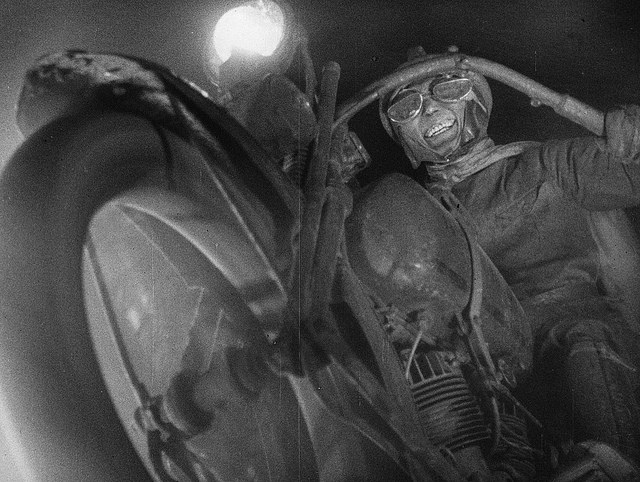
"Horizon lines and vanishing points can sometimes be about as rare to come by in Fritz Lang's cinema as tracking shots are in Yasujirō Ozu's. In 1928's Spies, because of the geometric enclosures of the sets and the frequently downward-facing scan of Lang's camera, the background of the 4:3 frame is nearly always a wall, the ground, or a cluster of set elements that foreclose the margins of the characters' space. As in the opening shot, which shows a padlock up close before two ominous gloved hands enter the frame to pry at the lock. Lang first conceives of a restricting visual field and then confines human figures within it—all the better to hint at the invisible forces that govern individual lives." Continued at Slant.

Monday, February 29, 2016

Knight of Cups (2015) A Film by Terrence Malick


"Like Reminiscences of a Journey to Lithuania, Jonas Mekas's filmed expedition to a family gathering in his homeland, Terrence Malick's Knight of Cups operates like a diary film, right down to the use of chapter titles to organize the plethora of footage recorded in Los Angeles. Where Mekas soberly planted day markers into his impressionistic sprawl, Malick gives us tarot card-inspired slates like “Judgment” and “The Tower” to loosely contextualize the wanderings of a melancholy hedonist, Rick (Christian Bale), who's less a conventional character than a mute compass for Malick and DP Emmanuel Lubezki's exploratory camera. And while Mekas's project sprang from a desire, as an expat middle-aged New Yorker whose tender disposition always seemed at odds with his hectic city of residence, to reconnect with his familial heritage, the latest from American cinema's mild-mannered outsider also functions rather transparently as an act of self-therapy." Review continues at Slant.

Monday, February 22, 2016

Forsaken (2015) A Film by Jon Cassar


"It's 1872 in Wyoming, the same false refuge for Civil War veterans zeroed in on by Quentin Tarantino in The Hateful Eight, only here there's the immediate reassuring aura that decency can and will be restored. Keifer Sutherland plays John Henry Clayton, a cowboy who fits neatly into the archetype of the moral hero with a conscience sturdy enough to keep his fast gun at bay (even his name is impossibly patriotric-sounding). John Henry's riven with familiar postwar angst and deteriorating faith, but early shots of him riding stridently across mountainous territory to tasteful major-chord crescendos ensures us that he's good at heart. When he gets home for the first time in years, he reunites with his reverend father (Donald Sutherland), who's lost confidence in his soldiering son, as well as an old love (Demi Moore) who's now hitched to, you guessed it, a jealous scoundrel (Jonny Rees)." Full review at Slant.

Tuesday, February 9, 2016

The Emigrants / The New Lands (1971 / 1972) Films by Jan Troell


"'We're the best of friends.' That's the endearment that a married couple, played by Max von Sydow and Liv Ullmann, whisper to one another in Jan Troell's The Emigrant. For anyone familiar with von Sydow and Ullmann's collaborations in the filmography of Ingmar Bergman, it's a deeply moving moment as much for its narrative context—Ullmann's character is suffering from seasickness aboard a ship to America as a storm beats against her cabin and fellow peasants wail outside the frame—as for its metatextual implications. The two actors sparred, trembled, and agonized together on screen so routinely under the gaze of the famously penetrating Swede that a comparatively blissful moment almost registers as a glitch, even as it doubles as a validation of the pair's fruitful working relationship. It's hard to imagine any fan emerging from the scene, sensitively prolonged by Troell in intimate close-ups, with dry eyes." Review of an excellent new Criterion Collection disc continues at Slant.

Thursday, February 4, 2016

Eisenstein in Guanajuato (2015) A Film by Peter Greenaway


"The history of artists working away from their homeland is rich with tales of creative flowerings: wide-eyed Paul Gauguin dispatching to Tahiti and expanding his palette, wacked-out Salvador Dalí descending on Paris to find a melting pot of artistic cross-pollination, globetrotting Orson Welles sticking it to American financiers by creating some of his most daring work in new lands, and Andrei Tarkovsky transcending both his nostalgia for his motherland and a rapidly deteriorating body with a series of deeply personal art films. Somewhere adjacent to this history is the curious case of Sergei Eisenstein's sojourn in Mexico, which serves as the subject of Eisenstein in Guanajuato." Continued at Slant Magazine.