Showing posts with label Eighties. Show all posts

Tuesday, September 11, 2018

The Sacrifice (1986) A Film by Andrei Tarkovsky


"In Andrei Tarkovsky’s The Sacrifice, the distance from hope to despair is a short jump—a chasm crossed with the help of something so immediate as a television transmission. As his birthday celebration winds down on a gloomy summer evening in remote Sweden, retired intellectual Alexander (Erland Josephson) tiptoes half-drunk into his living room to find a small company of friends and family bewitched by the soft blue glow of a TV set’s screen, out of which emanates an announcement of nuclear conflict. The warning winds down, the TV is turned off, and the mood descends—first into stunned silence, then into outright hysteria, and then into a kind of sedated anxiousness from which the film never quite resurfaces. In certain contexts, this dramaturgical pivot might register a bit maudlin, but in 2018, when Twitter and cable news provide an endless gushing stream of outrages, the film’s evocation of being rapidly thrown into disarray by a piece of topical turmoil hits home."

Kino released a new Blu-ray for The Sacrifice, so I reviewed it for Slant.

Thursday, September 1, 2016

Contesting History – The Films of Oliver Stone


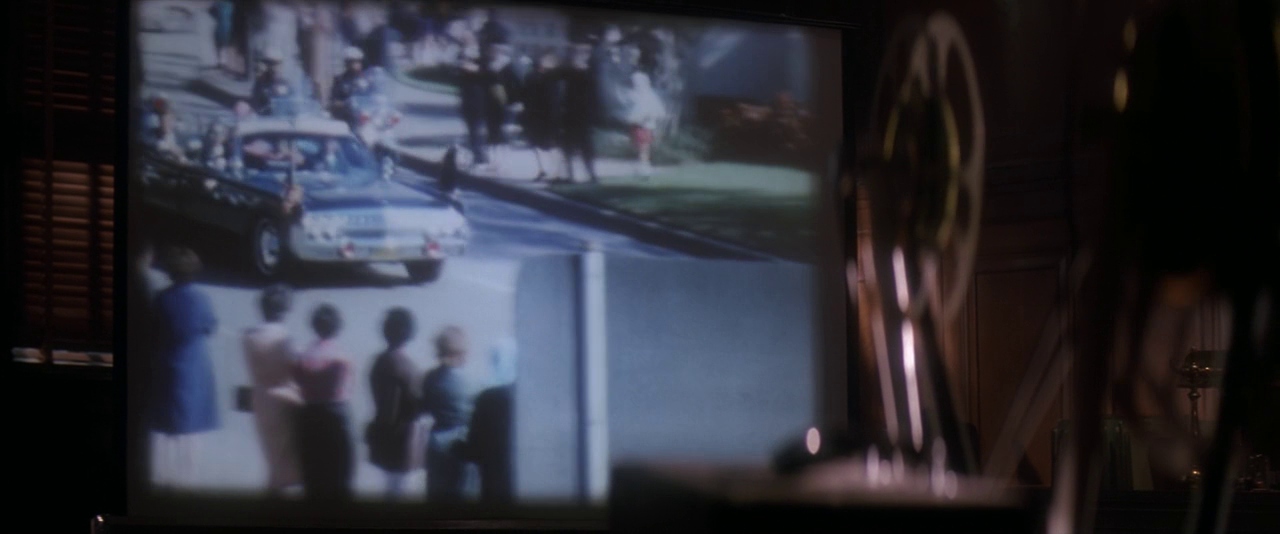
"Regarded as a politically radical firebrand nearly as often as he’s discussed for his filmmaking, Oliver Stone is one of the monolithic voices of contemporary Hollywood—a figure about whom opinion tends to be divided starkly between derision and adulation, with little room for ambivalence in between. As a veteran of the Vietnam War whose Bronze Star and Purple Heart belie a profound disillusionment with his experience there, Stone has spent a considerable chunk of his directorial career depicting the events of the 1960s and 70s, paying particular attention to the ways in which the era’s tensions and contradictions act as barometers for more enduring problems in American politics. His overarching thesis as a filmmaker—that passive faith in one’s nation leaves one blind to the fact that the interconnected forces of government and national media construct digestible narratives for their citizenry in ways that protect their own interests—doubles as a call to action, which therefore brands Stone as an activist working within the entertainment business, a perch from which he wields a rare influence."

The Harvard Film Archive is hosting a small survey of Oliver Stone's political filmmaking this fall. They generously asked me to contribute the introduction and, with the exception of the blurb on Snowden, all of the program notes for the series, which can be viewed here.

Thursday, May 26, 2016

The Holcroft Covenant (1985) A Film by John Frankenheimer


"Noel Holcroft (Michael Caine) doesn't know how to use a gun when The Holcroft Covenant begins. By the film's conclusion, not only can he hold one with the kind of cool poise expected of spy heroes, but he's also sharp with pistol disassembly and reassembly. This education dovetails with a plot that finds Holcroft, an honest New Yorker in the commercial construction business, becoming the victim of a transnational terror scheme and ultimately learning enough about it to singlehandedly upend its fulfillment of a prospective Fourth Reich. The year is 1985 (“Now,” as a title urgently informs us), a time in which the United States was still using counterintelligence to sniff out Soviet influence. Yet director John Frankenheimer and writer George Axelrod look at espionage and find the very concept a destructive breach of privacy and a route to anarchy, something for which active resistance—in this case, prowess with a firearm—must come into play." Full review here.

Thursday, October 8, 2015

Blind Chance (1987) A Film by Krzysztof Kieślowski


"In the beguiling but dense opening minutes of Krzysztof Kieślowski's Blind Chance, a series of succinct vignettes, arranged chronologically, but not in way that's immediately apparent as such, introduce us to Witek (Boguslaw Linda), a young Polish man. Strung together by the kind of ethereal theme music that would become a Kieślowski signature throughout the 1990s, various episodes from Witek's life play out as though the disconnected fragments of a pre-death hallucination. Among other vivid snapshots, he takes math lessons from his father, bids farewell to a childhood companion, peeps through a window as a child at an administrative meeting of some kind, kisses a girlfriend while being heckled by the occupants of a departing cargo train, and participates in an autopsy in a crowded medical room." Full review of the new Criterion disc here.

Thursday, December 5, 2013

They Live (1988) A Film by John Carpenter

While everybody rabidly chews up the year's releases in a mad dash for year-end lists (I'm doing some of that too, to be fair), my viewing highlight of the past month is most certainly a 25-year-old film that will get an IFC Center revival starting tomorrow: John Carpenter's exuberantly alive sci-fi satire They Live. The movie features a pro wrestler marching the streets of LA mouthing off to and pulverizing heinously deformed 9-5'ers; in the premise alone, there's basically nothing to object to. I get into some of the film's more complicated achievements, including why it remains one of Hollywood's most intelligent consumer culture takedowns, over at In Review Online.

Wednesday, May 29, 2013

The Thing (1982) A Film by John Carpenter


John Carpenter's The Thing opens in crisp whiteness and ends in a dark, smoky inferno, a fitting visual progression for a film that also shifts from relative normalcy and stability to paranoia and enveloping fear of the unknown. Its compositions are first airy and spacious, and later they are hazy and claustrophobic. Enemies are seen with perfect clarity when the film begins; by the end, it's not only difficult to spot them in the shadows, but it's nearly impossible to know whether they are an enemy or a friend. This is the linear descent of Carpenter's bleak, nasty horror film, and it's a shift that is carefully and tensely modulated over the movie's runtime. Plot is thin and characters are simply defined, the better to place emphasis on mood and tone.

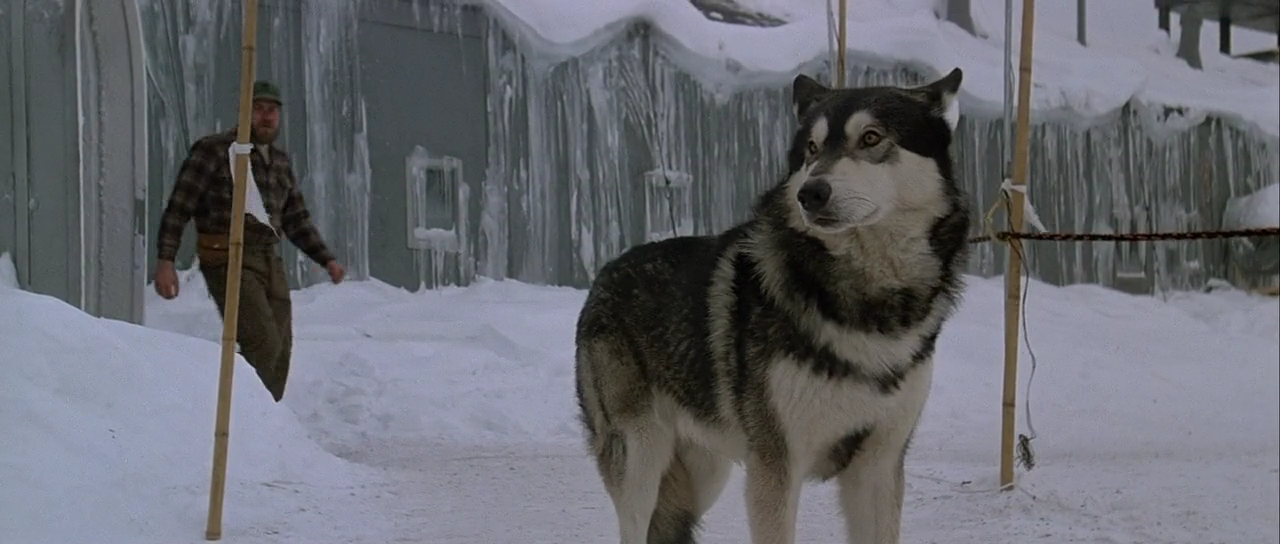
Simplicity is the name of the game in The Thing. A loose rehash of the premise of the Howard Hawks-produced, Christian Nyby-directed The Thing from Another World (1982) as well as a distilled adaptation of John W. Campbell Jr.'s novella Who Goes There?, Carpenter's film seems determined to minimize any specific associations with prior versions of the same material. It concerns a group of men at a scientific research station in Antarctica on an expedition only given context by a brief insert shot of the sign at their temporary base. Connection to the outside world has been cut off, while relentless gusts of wind and -40 degree temperatures envelop the crew at all times. The film begins with a random invasion from a Norwegian helicopter, whose only passenger is a crazed scientist hell-bent on sniping one of the crew's many faithful Alaskan huskies. The lunatic is swiftly dispensed with, but as a mysterious alien phenomenon starts to plague the base, the full implications of his fleeting appearance make themselves clear. By the end of the of the film's prologue, the simple conflict that sustains the entire plot has been established: a group of scientists fighting an unknown, rapidly-spreading parasite.

The nature of this parasite is elusive. An opening shot of outer space makes it clear that it is of an extraterrestrial nature, but it has no definitive size or shape. Instead, the alien (never seen in its pure form) latches onto a variety of hosts and attempts to "imitate" their physical body. At various points in the film, Carpenter reveals the different stages of this process: sometimes the alien is a heinous amalgamation of a known creature (human or dog) and a slimy, shapeless beast, and other times the alien has completed its full transformation into the likeness of its host. The vague, shapeshifting characterization of this Other begs one to interpret it along the lines of metaphor; therefore, instead of an actual external threat, it is a manifestation of any number of insecurities – fear, paranoia, mistrust, alienation – that arise within the group when confronted with an unknown force.


Unlike the Hawks-Nyby film, where character traits accumulate through a barrage of words, facts, and actions (a general Hawks tendency), Carpenter is more interested in the gradual reduction of character specificity. Characters become mere bodies ready to be cohabited by the titular alien presence, if not simply diminished to a basic survival mode. Whatever defining, archetypal features the people in The Thing start the film with (disco and roller-skating for Nauls (T.K. Carter), compassion and gentility for Garry (Donald Moffat), and scientific expertise for Dr. Copper (Richard Dysart), to name a few) evaporate as the film progresses. The closest thing to a headstrong protagonist, Kurt Russell's R.J. MacReady, has his leadership undermined by an array of disorienting cinematographic effects, most notably a creeping tracking shot late in the film that resembles a villainous POV only to reveal itself as MacReady as the shot moves menacingly through a door towards an unsuspecting character. Furthermore, the best source of scientific authority in the film, Wilford Brimley's Dr. Blair, is one of the first to lose his wits, leading to a frigid solitary confinement outside the base.

One by one, starting with the husky who escapes the Norwegian's gunshots in the beginning of the film and, up until he meets his grisly end, stalks the base like a premonitory Danny Torrance from The Shining, the characters in The Thing are brutally molested by the alien force. The scientists learn that their flamethrowers are the best means of staving off immediate threats, but they also understand that whatever method the alien uses to spread its terror throughout the group will remain frighteningly unknowable and dependably lethal (an early bit of wonky DNA-testing and computer research warns them that the creature's powers could annihilate the entire human race in no more than two days.) As the death toll rises in this small, tight-knit group, so too does hysteria, paranoia, and panic. Many of the film's early sequences occur in the open spaces of the Antarctic tundra, but later the scientists are confined to the cramped interiors of their base, where extraterrestrial liquids lay splattered across surfaces, ready to possibly birth new offenders or violate new hosts. Carpenter prefers clustered group shots to a frantic interplay of close-ups, emphasizing the close proximity of the men to one another even as any one person may not be what they seem.


The Thing's special effects hew closely to those of Alien (at the time released only three years prior), borrowing Ridley Scott and H.R. Giger's suggestions of violent oral assault and their emphasis on phallic-like extensions emerging from layers of thorny flesh. It's obvious that Carpenter felt compelled to coast on the hair-raising success of Scott's film, but despite his somewhat opportunistic thefts, his use of such a sexually charged monster to provoke male anxieties makes perfect sense in the context of a film about men struggling to put trust in one another. The alien only gets larger and more tentacle-driven as the film goes on, moving in sync with the scientists' growing uncertainty in the face of a powerful force uncontrollable through traditional science.

Ennio Morricone's doom-laden music – all synthesizer drones and spine-tingling cascades of strings – rarely lets up, laying on thick the atmosphere of fatalism and dread that guides the film to its logical, death-shrouded conclusion. It's a heavy, intoxicating score, perhaps a little too portentous at times, but it's one of the key elements that makes The Thing such a dark and oppressive experience (also, I should add, such a distinctly 80s experience – see also DP Dean Cundey's illogically beautiful neon stylings). Carpenter's film doesn't so much catch its viewer off guard with such relentless aesthetic decisions as drip slowly and inexorably towards an apocalyptic finale in which neither human logic nor divine hope will save these men from disappearing entirely from existence in an icy no man's land.

Tuesday, May 28, 2013

Intensifying the Affect: Peter Tscherkassky’s Virtuosic Repurposing Acts


(Note: The following is the last paper I ever wrote at Emerson College, an essay for my History of Experimental and Avant-Garde seminar.)

Looking for a world’s essence is not looking for what it is as an idea once it has been reduced to a theme of discourse; it is looking for what it is as a fact for us, before any thematization.
                -Maurice Merleau-Ponty, "What is Phenomenology?"

Substitute “world” with “film” and one has a fairly instructive credo for digesting the work of Austrian avant-garde filmmaker Peter Tscherkassky (1958 - present). Since his first short film in 1981, Tscherkassky has sought increasingly imaginative ways of transcending conventional pictorial representation in cinema, producing radical aesthetic experiences that intentionally gesture towards visual coherence before completely unsettling any sense of spectatorial stability. Provocatively touted as “the most important and most internationally celebrated contemporary avant-garde filmmaker,” (Möller) much of his work has been the subject of psychoanalytic and philosophical analysis, but the films explored in this essay – Motion Picture (1984), L'Arrivée (1997/98), Outer Space (1999), Dream Work (2001), and Instructions for a Light and Sound Machine (2005) – suggest a desire to move beyond constricting modes of thought towards a new iteration of what Germaine Dulac deemed Cinéma pur; that is, a cinema with expressive qualities divorced from those of the other art forms based on “the power of the image alone” (34). Even as these films toy with structural framing devices, historically and theoretically loaded found footage material, and broader trends in the history of Austrian avant-garde cinema, their continual focus on material vulnerability reflects a larger interest in the fragility of various frameworks of thinking.

For the greater part of Tscherkassky’s career, this pursuit of pure cinema, absolute film, or immersive abstraction – whichever you prefer – has been tied to the photographic dark room. Starting with Motion Picture, Tscherkassky has been devoutly tied to celluloid film stock (both 16mm and 35mm) and hand processing (developing his film using his own chemicals and his own special methods). Integrating dark room manipulation of found footage stock into each of his works, not to mention producing his films entirely in this way for over a decade, Tscherkassky scratches, smudges, distorts, reprints, rephotographs, and multiplies his source material, in the process often abandoning any trace of the traditional point-and-shoot recording process that marks the vast majority of film production. Much of this work is accomplished with an optical printer, a device that allows one to scrutinize and maneuver individual film frames. Other times, Tscherkassky’s manipulation is entirely hands-on, in which case the effects seen in the finished films are produced through direct physical contact (abrasive or controlled) with the celluloid.

Thursday, July 26, 2012

Boy Meets Girl (1984) A Film by Leos Carax

Perched between compulsive citation and the kind of brooding, morbid anxiety that might characterize an older, more world-weary filmmaker, Leos Carax's Boy Meets Girl is about as atypical as directorial debuts get. The film's opening voice-over - set atop a mysterious montage of three images ending in a frenetic view of The River Seine at night and spoken in a craggy voice that could just as easily be a 100-year-old woman or a 12-year-old girl impersonating her grandmother - establishes the movie as the free-associative visions of a dying filmmaker:
"Here…we are…still…alone. It is all…so slow…so heavy…so sad…soon…i…will be…old…and…it will…at last…be over…"
But the film is anything but that. Instead, the narration marks the first lines to introduce the world to the 24-year-old French filmmaker and one-time Cahiers du Cinema writer, and they immediately intone a sense of finality and apprehension over both the film and ultimately Carax's career, in which every film continues to feel uncannily like The End of something. Boy Meets Girl was routinely identified upon its release as the resurrection of the youthful spirit of the French New Wave, the kind of film Godard would have been making had he never matured beyond his jazzy, guerrilla-style romances, and it's become something of an accepted idea that it is. The consensus was missing the point though; Carax, an outspoken Godard fan, was making the Last New Wave film, a work that consciously evoked Godard and other Cahiers disciples even as it deliberately set itself apart from the movement. Still today, when we make knee-jerk comparisons of Carax's early work to Godard and Truffaut, we're denying ourselves the ability to see the poetic singularity of Boy Meets Girl.

In fact, if we disregard for a moment any surface resemblances to Godard (the Karina look-alike Mireille Perrier and her Band of Outsiders-esque tap dance, the naked, articulate dialogue, the delinquency motif), a closer spiritual precursor to Boy Meets Girl isn't Breathless or The 400 Blows but rather Last Year at Marienbad, a film that never fit comfortably into the energetic, juvenile umbrella of the New Wave movement. Both films are elusive romances told from the frustrated male perspective, both are situated within a hyper-extended microcosm of reality, or a hypnotic dream space with the appearance of the physical world, and both use a game (Nim in Marienbad, pinball in Boy Meets Girl) as an occasional metaphor for the ubiquity of chance in the progression of their characters. Carax, like Resnais, even halts the flow of the cinematic world in several instances, making figures freeze in time while the main characters continues to move about. All of this suggests that the 24-year-old Carax's concerns were different, and in some cases far broader, than the 30-year-old Godard's.

Boy Meets Girl represents the first use of Carax's onscreen surrogate Denis Lavant, a herculean actor (in 1984, a non-actor) who has featured prominently in every Carax movie (with the exception of Pola X) through the recent masterpiece Holy Motors. Lavant plays Alex, the figure at the center of each of Carax's first three films, a young delinquent and loner who keeps a brain-like map of his life experiences behind a painting on the wall of his scantily furnished one-room apartment. The map charts, seemingly arbitrarily, the landmark events in Alex's life, and early on in the film he inscribes "first attempted murder" in the middle of blank wall space after Carax shows him strangling the man whom his recent girlfriend cheated on him with. It seems merely a matter of time before all the empty space on the map will be filled with further experiences of Alex's own design; a self-described "filmmaker" who only dreams up titles of films he'd like to make, there is a sense that Alex is trying to steer his own fate. He uses different chunks (theft, murder, break-up, filmmaking, at one point he refers to having not cheated yet) that can be built into a unifying whole, a complete personality. He's glimpsed a pre-destined shape for himself, and the film is part of his attempt to build himself into that shape.

Through a strange sequence of events, Alex sees it as part of his idealization that he must fall in love with a recently heartbroken failed commercial actress named Mireille (Perrier). For Carax to illustrate this idea, he constructs an unpredictable narrative progression to open the film. After the aforementioned narration, the film reveals Maite (Maïté Nahyr), a woman who's "driving to the mountains" with her baby daughter, and a pair of skies and poles protrude absurdly through her front windshield. When she pulls over to the Seine, she calls a man named Henri and informs him that she'll be throwing his paintings in the river, then runs over to a man named Thomas (Christian Cloarec) to ask him for the date and time before leaving in her car again, dropping a checkered scarf that matches Alex's sport jacket in the process. Alex then arrives and attempts to kill Thomas at the edge of the bridge, eventually pushing him off. This segues to a gloomy-looking Mireille in her apartment wearing a similar black-and-white pattern on her pants. Her boyfriend Bernard (Carroll Brooks) sits on the bed across from her and enigmatically exits the room moments later saying he "can't talk about [something] here and now," leaving Mireille in confusion. The ensuing break-up occurs through the intercom outside the entrance of the apartment building, where the wandering Alex stops to be a front-row witness to the action. Having just been dumped himself, Alex formulates this as a cosmic exchange of heartache, a turn of fate that allows him to pursue Mireille with utter determination.

This progression of scenes demonstrates Carax's associational montage, which carries the film along according to impulses, emotions, and sensations. Because of Carax's elliptical editing and his propensity to highlight miniature gestures and seemingly insignificant elements in the mise-en-scène - Thomas grabbing a knife while being strangled, Bernard throwing out some kind of tickets from his coat pocket, the blaring Dead Kennedys song that Mireille listens to while being dumped - it's easy to miss narrative details in this sequence, and throughout Boy Meets Girl in general. I'm still trying to unpack the nature and significance of Maite, a character deliberately aligned with Florence, Alex's actual ex-girlfriend, who, like Maite, also threatened to extinguish her ex's creations (in Alex's case, his letters to her). Furthermore, why does she drop Florence's scarf, or does she just happen to have the same article of clothing? Soon after, Alex watches a couple kissing by the river, and the women, whose entire face is never seen, appears to be Anna Baldaccini, the actress credited as Florence, but the man she is kissing is not Christian Cloarec. Intentional or not, these narrative ambiguities contribute to the film's dizzying self-reflexivity and also suggest the way that Alex has tried to depersonalize and obscure his troubled recent past.

Carax himself - whose name is an anagram of the first and middle names of his birthright Alexander Oscar Dupont - is a prankster, and his complete kinship with the anarchic Alex is transparent. Alex spends his time documenting his experiences on his typewriter and filing old letters he has written, and in order to insure the posterity of his feelings he Xeroxes them. The relationship between his methods of observing and preserving reality and the cinematic apparatus is hinted at by Carax through the repeated visual motif of framing Alex within larger frames: a window overlooking subway stairs, an elevator, a phone booth (the glass of which is broken to reveal its own circular lens), not to mention Alex's tendency to observe intimate moments (Bernard and Mireille's break-up, the lovers' kiss on the bridge) from close distances, like a spectator in a theater. Reflections and doubling also take a strong thematic role. At the Xerox store, Alex stands behind identical twins who are placed in front of a large mirror. Notably, Mireille's apartment features a window overlooking both a courtyard and another apartment building that takes up the entire surface of a wall, and she continually sits against it, allowing her faint reflection to have a ghostly presence in the frame. If Boy Meets Girl deals with how our ideal self(ves) are thwarted and redefined by chance, by the intrusion of unexpected life circumstances (hence pinball), then in the final scene, Carax demonstrates how far the ideal self can be distanced from the real self by returning to the image of happy lovers in a window across the courtyard. Thus, the film acknowledges its own conceit of cinema as a duplication of reality as inherently flawed, while at the same time making it known that this striving for the ideal is nevertheless essential to living.

If cinema is not a duplication of reality, it's a construction of it that is subject to its maker's personality and context. Boy Meets Girl, accordingly, is an extremely personal film, as well as a work that is very alert to its own place in cinema culture and film history. During the climactic, titular meeting between Alex and Mireille, Perrier calls explicit attention to her bum tooth and longtime wrinkles, which bluntly separates her from the famously polished Karina. It's as much an example of Carax distancing himself from the shadow of Godard as it is Mireille bearing her soul for Alex, just as a mysterious bourgeois party set piece at the heart of the film (which includes a very meta monologue about silent cinema by a deaf man), with its smoky ambiance and frozen intellectuals, is both a love letter and a farewell to the world of Marienbad. In a broader sense, Carax, the man to propose "the silent talkative film" (see: Fergus Daly and Garin Dowd's book Leos Carax), positions the film in a nebulous middle ground between the potential of silent film and the potential of sound. Like a great deal of mid-century European art films, Boy Meets Girl is entirely post-synched, drawing attention to the divide between the image and the construction of the sonic diegesis. (Its soundscape is one of its most unique features, but that's a topic worthy of another essay.)

In Boy Meets Girl, the setting of Paris seems incidental, and it continues to be in Carax's body of work. The city is nearly unrecognizable through Carax's highly posed, nocturnal universe. Areas of the frame that Carax has no interest in are reduced to murky negative space. Bodies are situated against expanses of black, an effect that is often called upon, illogically, during moments of great introspection. What's in the frame and what's visible is always a highly selective act for Carax, so the setting of Boy Meets Girl feels like an afterthought. Indeed, for a young filmmaker, this counts among the highest praise. Carax's selectivity is mirrored by his understanding that filmmaking is about the search for identity. Like Alex, it's defined by being in a perpetual transitional state. Twenty-eight years after the release of Boy Meets Girl, Carax is still producing work that revels hypnotically in the dark.

Wednesday, February 8, 2012

L'Argent (1983) A Film by Robert Bresson


Boiled down to its essential actions, Robert Bresson's final film L'Argent might just resemble a bunch of people opening and closing doors and handing each other money and documents. However, through the precision of Bresson's editing and his rigorous command of compositional space, the film becomes a haunting, suggestive summary work about just how far our capitalistic, materialistic civilization has sunk. The characters in this hushed atmosphere of oppression and doom - in which the omnipotent dictator is money - are the ghostly shells of humans who once possessed dignity and desires and have now become little more than transmitters and receivers. Indeed, for the film's first thirty minutes, money seems more of a character than any single individual; a forged banknote is passed from hand to hand, sparing some and devastating others, and Bresson shoots it in close-up, as if a human face. Finally, after some opportunistic hoodlums spend the counterfeit bill and set off a chain of confusions and disruptions, the seemingly innocent delivery boy Yvon Targe (Christian Patey) puts it to use, unaware of its artificiality, and gets arrested, in the process become the central character of the film.

When reduced to a linear précis, Yvon's ensuing downfall may appear ruthlessly schematic: he loses his job, turns to petty crime, finds himself in jail, loses his child to disease, loses his wife to contempt, and becomes a thief and murderer. But Bresson's construction is so elliptical, his storytelling so pared-down, that Yvon's ignoble path starts to feel less like the product of an inner demon slowly emerging to the surface than it does a harrowing accumulation of survival mechanisms demanded of him and nurtured by a society where rigid institutional codes of capitalism and the judicial system have suffocated single voices and drained essential human values. In this milieu, humans have been cast astray from their natural impulses, instead forced to adhere to the massive governing umbrella of commerce if they want to get ahead in life. There is a suggestion that in such a society, no one can be truly innocent; everyone is either already guilty of betraying the law or is soon to be guilty, not to mention that on a more metaphysical level, everyone is guilty. Early in the film, Yvon attempts to sue the female shop-owner (Didier Baussy) who lent him the counterfeit in change, but she has calculated a lie to the court and bribed her shop assistant (Vincent Risterucci) to do the same. As a result, Yvon is unfairly convicted. Ethics and morality have disappeared, and only transactions remain.

In response, Bresson's style is truncated to a visual language of transactions. Nearly every shot features a hand placing something in a pocket or greeting another hand with something. Greed, deception, and ignorance all find expression through hands, and Bresson finds subtle shifts in the several uses of the body part. At one point, Yvon, hoping to commit suicide, collects the medicine provided to him in solitary confinement through a process in which he receives it from a guard, pretends to consume it, and subsequently hides it beneath his mattress when the guard walks away. Shortly after swallowing his large stash, Bresson efficiently cuts to a shot of a few inmates watching out their small window as Yvon is carried away in an ambulance. The very content of the sequence is communicated solely through body language and the poised intimacy of Pasqualino De Santis and Emmanuel Machuel's claustrophobic camerawork. Verbal communication, on the other hand, comparatively rare and resolutely mundane, is also transactionary. It is telling that the final scene Yvon and his wife share together takes place with a pane of prison glass in between them, their eyes averting each other and their voices abstracted through the small holes in the glass. (This transparent boundary, at once creating a sense of immediacy and distance, might as well exist between every character in the film.)


Much of L'Argent's downfall narrative is telegraphed through scenes like Yvon's attempted suicide - that is, through the power of restraint and innuendo. A mysterious scene early on showcases Yvon's desperate quick stint as a getaway driver without revealing much information. Later, it's easy to miss Yvon's inaugural murder, which is reduced to a brief foreshadowing shot of him eying a knife in the prison's kitchen and a subsequent, similarly short close-up of his hands under a sink as he scrubs blood away. Bresson preserves a sense of uncertainty with his clipped, boxy mise-en-scene, always shooting in medium shots or close-ups and refusing to visually complete the space in between people, objects, or actions. Particularly in the first example, there is little concrete evidence to prove that Yvon is indeed the getaway driver because Bresson's austere intercutting between a shot of him looking out of the car window screen right, a shot of policemen pointing their guns screen left, and a shot of two people fidgeting behind the huge glass wall of a bank deliberately restricts a tangible mental construct of the space. An analogous situation exists in Yvon's climactic slaughter of a rural family for a trivial monetary gain. Knowledge of the grisly events taking place arrives either tangentially through shots of a dog skipping across the rooms of the cottage, growling at a perceived intruder, or belatedly in shockingly direct images of fallen, mangled family members. It's a breathtaking, uncompromisingly fierce scene, both for the way in which Bresson stages and shoots it (Yvon carries an oil lamp through the pitch-dark cottage, and its orange light, stretching across the dark brown wood of the walls, quickly becomes a stand-in for his presence) and the way that it represents a sudden culmination of Yvon's misfortunes, a garish outburst of the feelings of anger for being cheated, abandoned, and left penniless that are bubbling within him.

With the exception of this unexpected intrusion of real, visceral horror, the film is pitched at an almost ludicrous deadpan throughout, emphasizing the absurdity of society's hierarchical structures and behavioral norms. Bodies move from space to space as if their joints are constructed with metal, droning voices quickly submerge into featureless surrounding walls, and doors abruptly shut or swing bluntly until they reach the conclusion of their graceless pendulums. Bresson evokes a world where humans have been fenced off from their own environments, where the steel confines of a jail are no different than the equally firm boundaries constructed by society. A recurring shot of prisoners being escorted through a gate - framed such that their heads are cut off and only the gate is in crisp focus - is exquisitely ambiguous: are they entering or exiting prison? And more strangely, does it matter?

Monday, August 15, 2011

My Dinner With Andre (1981) A Film by Louis Malle


At one point during the long, enthralling, unpredictable conversation between theater professionals and long-time acquaintances Andre Gregory and Wallace Shawn, the two embark on a the perplexing question of whether or not art can still move people to change their lives. The inquiry revolves around two sides: Wally's belief that the revealing of life in all its banal, meaningless totality can wake people up to its fundamental shortcomings, and Andre's rebuttal that such subtle maneuvers aren't good enough any more, that people must be taken well out of their comfort zones and experience something entirely unexpected, an idea he analogizes to being atop Mount Everest. As if by some magical sleight of hand, Louis Malle's My Dinner With Andre, the deceptively nondescript cinematic experiment that contains this talk in 110 minutes, finds a middle ground between these two poles by taking us into the heart of cosmopolitan NYC for a seemingly bland and routine dinner yet also to the top of Mount Everest, into surprising territory where the realization of mundanity and the pursuit of transcendence go hand in hand. The unspoken answer offered by the film is that yes, art can change lives. Or at least it can lead people to consciously think about their lives in a way that encourages change.

As the film's scenario begins, Wally (that guy whose distinctively helium-headed vocal delivery pops up in small doses in all sorts of middle-of-the-road Hollywood fare from Toy Story to The Princess Bride to The Incredibles) is the struggling playwright and no-nonsense pragmatist while Andre is the experimental-theater-director-cum-enlightenment-seeker who sprays his New-Agey mysticism at Wally with giddy, seemingly endless intensity. The thoroughly complementary nature of their characters, which naturally extends to their physical statures (Andre's lanky Bergmanesque frame, Wally's frumpy pudge), at first seems too easy, but the question arises by the end of the film as to whether or not their perspectives remain so dialectical. My Dinner With Andre, obviously, is a film about conversation, but it reveals its subject on a Rohmerian scale; it's about the ways in which the bouncing of ideas can open up new and hitherto unexplored pathways of thought, and the way that talking and talking and talking can actually pervert an initial, intended idea rather than crystallize it. Wally, who is ostensibly the film's protagonist if only because his interior monologue bookends the central conversation, is not looking forward to his dinner with Andre, who he has heard is in a funk after a rabid succession of journeys around the world and his mother's death. Yet the act of talking, at first casually and superficially but ultimately with deep introspection, is able to reverse his preconceived notions of this obligatory meeting with a past colleague. Through eye contact and listening, the unavoidable is quickly made vital, the disposable made eternal.

Andre, the well-spoken lad who chose the timeless, upscale restaurant where they meet, is off to the races about his various encounters with exotic peoples and bizarre rituals the moment they sit down. An experiment in acting with 40 singing-and-dancing professionals in the dark woods of Poland, a retreat to an esoteric community of insect communicants in Scotland, an absurd adventure through the Sahara Desert with a Buddhist monk; Andre recites these stories with alarming clarity and detail, as well as an exterior assurance that would belie his emotional turmoil. For a majority of the time, it's almost as if he'll never stop, and Wally just listens and adds the temperamental "um-hmm" or "So what did you do next?" Andre is so relaxed playing himself that the experiment of self-replication acting that he describes passing on to his 40 Polish comrades appears to be the thesis behind his own stunning naturalism in the part. It's not a matter of merely sitting in front of the camera and behaving normally; Andre and Wally spent months performing and refining the script of their conversation in various locations, thus the film is a document of two people's contrived representations of themselves.


For nearly half the film it's almost as if the same image of a contemplative, attentive Wally was simply inserted hastily from time to time to break up the extended showmanship of Andre, but slowly Wally reveals his own agency. Chomping at the bit to provide a counterargument to Andre's admittedly one-sided and privileged view of "truly living", Wally finally claims an opportune moment to launch into a celebration of the smaller, less glamorous pleasures of quotidian city life (a mode Andre finds dangerously "Orwellian"). Suddenly the dynamic of the conversation has taken a drastic 180 degree turn, with Andre, glanced frequently through the mirrored walls behind their table, offering generous nods and chuckles and only the occasional input. It is not long before their conversation has veered off entirely from the specific and into the abstract, a discursive string of unsettling philosophical arguments about reality, perception, love, and communication itself. Yet, ever so delicately, Andre and Wally maintain their casual naturalism, the sense of two Manhattanite intellectuals catching up on lost time, never falling into easy academic platitudes.

Malle captures it all (perhaps one of the least exciting scenarios possible from a cinematic/directorial standpoint, but Malle was always up for a challenge) with wise restraint and aloofness, limiting his restaurant set-up to a two-shot, close-ups, reverse angles, and the occasional imperceptible dolly move. But, to fall back on the cliche, the talk is what matters. There is very little that makes My Dinner With Andre very cinematic, but then again it shares none of the theater's showy overstatement, or even the performative spectacle of Andre's own real-life Manhattan Project. Its sense of camaraderie and realism are decidedly unshowy, and its demanding, thematically dense script bursts apart the scenario's pedestrian simplicity. Most of all the film is a one-off in the purest sense of the term: resistant to replication or homage, it defies categorization.

Tuesday, July 12, 2011

Almanac of Fall (1984) A Film by Bela Tarr


Just before Bela Tarr finally settled on the characteristic black-and-white, long-take formalism that he's become widely respected for in his later work, he made Almanac of Fall, a jarring transitional piece that attempts to suddenly marry the freewheeling social realism of his early career to a sophisticated and rigorous visual style. It's a social drama perched uneasily between down-to-earth sympathy and the more cosmic observation of films like Satantango and Werckmeister Harmonies, and as a result it's never fully satisfying as narrative or as allegory. When placed within the context of Tarr's artistic progression, however, it's a compelling work, flirting as it does with all of the cinematic staples the director would eventually fully embrace. Set entirely in an old apartment that feels at once cramped and labyrinthine, the film navigates the conniving power struggles of an aging woman (Hédi Temessy), her greedy and immoral son, his former teacher (Pál Hetényi), a housemaid who tends to the woman's health (Erika Bodnár), and her discontented partner (Tarr regular Miklós Székely B.). Tarr sticks rigidly to the simplicity of this scenario, never leaving the apartment and mostly unveiling the drama through long two-character exchanges. For the modesty alone, not to mention the implicit challenge of keeping things lively and interesting in such a limiting set-up, Almanac of Fall is an admirable exercise.

The flip side of the coin is that as much as Tarr's ingenuity in framing the central drama is praiseworthy, the content frequently cannot hold its own. Despite the ubiquity of dialogue and character, the film is oddly one of Tarr's least propulsive, searching desperately for quite a while to find some semblance of narrative momentum in the lives of these downtrodden and unhappy individuals. Eventually that kick does arrive when the maid sleeps with the teacher who is boarding at the apartment in the event of severe economic hardship, a mostly offscreen sexual encounter that slowly unleashes bitterness and jealousy in her partner, distrust from her client, and heightened sexual desire from the woman's son. Before this point, however, the film is frustratingly stagnant, reducible to a series of one-sided conversations in which one character muses about anything from his or her existential crises to simple day-to-day money issues. This is a very specific milieu of post-Communist Hungary that Tarr is zeroing in on here, the same context he would go on to symbolically deconstruct later in his career, and as such we get an up-close-and-personal understanding of the tepid and confused social atmosphere. The early dialogues often go unanswered by the listening party, a suggestion that the struggles of an individual in this climate cannot be solved or soothed by anyone else. Everyone is on their own, fighting their own battles, be it economic, political, social, or sexual.

To express this unrest, Tarr uses a garish color palette of hot reds and murky bluish-greens. Dictated less, as far as I can tell, by specific symbolical purposes and more by a general air of heightened emotion, these colors emanate from room to room with seemingly no domestic logic; a splash of green will glow in a backroom as if an obscure scientific experiment is going on while a face in the foreground is smacked by an orange light that seems to be shooting from the floor. At several points, the black boots of the teacher appear malicious as they trudge through the living room of chiaroscuro red and black. (Already, it's clear that Tarr is establishing a potent shorthand for black boots and pitch-black pea coats, a wardrobe pulled from noir that nonetheless has its own distinct flavor in Tarr's oeuvre.) Other times, the light is less harsh, almost as soft as the colors in Kieslowski's The Double Life of Veronique, particularly in an early scene of rare camaraderie between the woman and her nurse where the two laugh and discuss the nurse's romantic endeavors. Still, Tarr's continued use of lurid, unreal shades manages to extract the buried sense of anger that Temessy is able to so thinly veil towards the nurse until later in the film.


In fact, the film's best scenes are marked by these exchanges where an emotional subtext boils beneath the mostly calm dispositions of the two characters speaking. When the nurse's partner shaves the face of the teacher - whose sexual behavior with the nurse he is only vaguely aware of - Tarr's camera slowly circles the two, capturing the illicit bloodlust of the scene, the fact that he could dig right into the teacher's face at any time. Furthermore, Tarr's uncomfortably intimate sound design lays bare all the quiet breathing, grunting, and scraping, which uncovers an implicitly homoerotic tension as well. Yet later, Tarr's clever mise-en-scene can't fully justify the more one-dimensional realization of the bitter emotional undercurrent between the two: a startling shot from beneath a glass (or plastic?) floor watching as the nurse's partner violently beats the teacher into it. It's a moment that's more exciting for the unexpected way Tarr shoots it than for the actual act of violence onscreen. More effective are the instances when the outbursts explode to the fore after long and tense discussions, such as the one between the woman's son and the teacher in which the son interrogates the teacher about the presence of his mother's valuable piece of jewelry in the interest of selling it and running away with the nurse, eventually holding a broken glass up to his neck in ugly greed. The whole affair turns into a game of violent and scheming one-upmanship, with each of the characters pulling their own selfish pranks to achieve money or sex.

If Bergman's heated chamber dramas were marked by their firm establishment of a single space to highlight the insanity of monotony, then Tarr's is notable for its stubborn refusal to make the stage remotely recognizable from one moment to the next. The old woman's apartment is seemingly medium-sized and traditionally laid-out, but Tarr's searching camera makes it so that every room feels new, some serpentine diversion from the central plot of the house. Much of the scenes are shot in roving telephoto from behind indistinct foreground objects, focusing on the haggard faces yet never losing sight of the larger space in which they speak. One can sense Tarr beginning to distance himself from his characters until finally deciding to settle on an almost cosmic perspective in later films; one such clue comes early on when mother and son argue and the camera slithers back and forth from behind an indoor gate, occasionally sliding behind total blackness in a way that recalls the opening scene of voyeurism in The Man From London. Still, the ultimate sensibility of Almanac of Fall is not nearly as complex or open as those later masterworks. A final scene of atonal celebration in which all the characters' frustrations with each other seem to have been extinguished cements the bleak message Tarr is conveying; set to a pop song whose thesis is the inevitability of fate, the suggestion is that these people will remain deadlocked in mutual tension no matter how hard they try to break free from their dour situation, as if only an outside force can pave the way to happiness and stability. As Tarr's career continued, that force would become abstracted and untrustworthy, and his desperate search for the dignity of individuals would become increasingly nuanced and hopeful.

Sunday, January 30, 2011

The Sacrifice (1986) A Film by Andrei Tarkovsky


The Sacrifice is the unusual brainchild of Andrei Tarkovsky and Ingmar Bergman, two of my favorite filmmakers, and as such there’s no reason why it shouldn’t be one of the greatest films ever made. Granted, Bergman never touched the project. It’s just that his influence rubbed off on Tarkovsky so saliently – the Swedish location, the Swedish cast peopled by Bergman regulars, the penetrating family drama – that it feels as if the two were co-directing. In actuality, Bergman’s piercing psychological investigation via earthbound drama is often in competition with Tarkovsky’s unpsychological, spiritual mysticism, resulting in a film that is split in half by the two sensibilities, never confidently blending them. Yet even this tension produces something of great interest, because while Tarkovsky lacks the tact and fluidity of Bergman drama, this ineptitude only amplifies the onslaught of poetic soul-searching that the film settles into, intensifying it in contrast to the comparatively stale talkiness of the first half. Though not his most accomplished work, like all of Tarkovsky's films, The Sacrifice's bold mystery and haunting imagery only grows in the mind after its completion.

There's also a good chance that this fissure in the film's structure is indebted to Tarkovsky's thematic position that there's a drastic disconnect in the world between humanity's material and spiritual development. Early on, the film's main character, Alexander (Erland Josephson), a retired actor and philosophy professor, muses openly to his deaf-mute son (Tommy Kjellqvist) about this very idea that modern mankind has abandoned any sense of spirituality to become smitten with all forms of material ownership. If not for the beautiful languid pace of the camera as Alexander speaks, roving through the skinny trees and tall grass swaying in a light breeze, the scene would smack of didacticism, existing as a rather pat summation of the film's concerns. The same goes for the rest of the first half as well, as Tarkovsky stages banal philosophical discussions among Alexander's family that are salvaged by the striking choreography of bodies, the way his camera manages to effortlessly glide into grand compositions. In their rote intellectualism and directness, Alexander's conversations with his friend Otto (Allan Edwall), his estranged wife Adelaide (Susan Fleetwood), and the rest of their acquaintances are never entirely believable. But when news of a nuclear holocaust surfaces on the television, the family grows convincingly solemn, with the exception of Fleetwood, who hams up a crying fit before thankfully being put out by Otto with a powerful sedative.

Fortunately, the film witnesses a sudden injection of life at this point, even though it ultimately grows quieter, stiller, and more threatening. Alexander makes a bargain with God - in a scene shot from an omniscient aerial perspective by Tarkovsky and regular Bergman cinematographer Sven Nykvist - that if he and his family surrender the totality of their material existence, the nuclear warfare will not occur. Only a character with the kind of all-consuming religious faith that Alexander possesses could argue for such a seemingly hasty and absurd pact, and only a director as gracious and believing as Tarkovsky could bring such dedication and compassion to the presentation of his spiritual pursuit. The Sacrifice cycles through dreams, hallucinations, and real events to depict a complex firsthand understanding of Alexander's spiritual predicament. In the film's eeriest scene, Alexander wakes up in a quiet, black and white space where, after Tarkovsky scans the ground for relics of the past in one of his familiar touches, the coming of a strong wind represents a jolting obstruction to the peaceful dream. The camera then tracks sideways through the house's hallways, glimpsing in the background a nude body skipping away in slow motion, birds taking hesitant flight around her. Color gradually saturates the frame, and miraculously the shot transitions back into reality.


But is there any certainty of this? There's a line in the film about reality being malleable, ever-shifting, and basically an illusion, and this is made concrete by Tarkovsky's tricky approach. He's consistently swapping film stocks, playing with perspective, confusing spatial understandings, interrupting any notion of linear time, making it unclear what a stable basis of physical or temporal reality is. Even before Alexander's pact, Tarkovsky rather noticeably invites harsh distortions to the natural color palette, layering a reddish-brown or greenish filter over the primarily gray interiors of the seaside home. After the news has struck, the family maid, known around the countryside as a witch, is standing outside the house in a patch of tall trees. While looking towards the vicinity of the camera, she calls softly to Alexander, after which the camera slowly dollies in, seemingly predicting his movement. But then Alexander emerges from the right side of the frame; we're not the only ones thrown off, for the woman turns in slight surprise too. Later, Otto and Alexander stare through a window at the sacrificial icon painting that graces the screen during the film's credits. Tarkovsky employs a classic shot-reverse-shot structure with tight close-ups of the painting and the faces of the two men, but once Otto walks out of the frame and Alexander motions forward towards the painting, he is revealed not to be standing right in front of it, as the intimate shots would suggest, but instead across the room from it, a good ten feet away. All of these mutations to traditional film grammar subtly jostle the viewer out of their comfort zone, creating sequences that never quite luxuriate in an accurate approximation of the world but rather approach an abstract, hallucinatory zone.

That Tarkovsky retains belief in Alexander and doesn't resort to smug snickering even when he is sneaking around his family, rummaging through their things, and ultimately burning their house down when he immerses himself fully in his spiritual convictions in the explosive climax is a testament to the deep spiritual connection he has to his artwork. The Sacrifice is not afraid to risk absurdity itself in the radical nature of its structure - long slabs of real time combined with elusive, dreamlike montage - or in the extremity of its content, making it, and its creator, analogous to the central figure, a man doggedly tied to religious piety and opposed to modernistic tendencies. Somehow, the film's most wayward ideas, spawned from lofty concepts about the limits of faith and reason, like the virtual reprise of a scene of levitation in Mirror or the ten-minute-long house-burning sequence, a combination of cinematic grandiosity and improvisational vérité, work in the context of Tarkovsky's consuming seriousness. And of course, this shouldn't devalue the sheer craftsmanship at work, such as the beautiful contours in the bifurcated design or the rich ambiance in the interplay between Bach, obscure Japanese bamboo flutist Watazumido-Shuso, and the subdued natural sounds. Thus, in all its contradictions and minor missteps, The Sacrifice emerges as an essential Tarkovsky work, a film so devoted to its esoteric spiritual themes that it becomes a kind of Bible of its own.

Tuesday, January 25, 2011

Santa Sangre (1989) A Film by Alejandro Jodorowsky


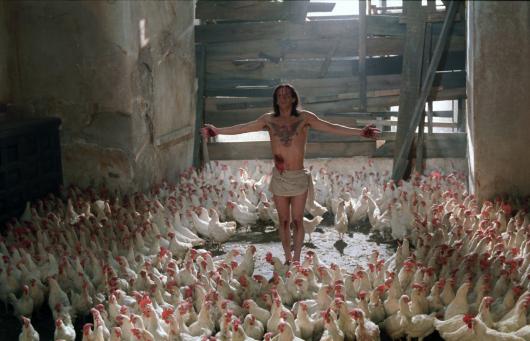
For all its admittedly surreal flourishes and bonkers left-turns, Santa Sangre is actually provocateur Alejandro Jodorowsky's least anarchic film (if we take his disowned The Rainbow Thief out of the picture), for within its hysterical madness there is a traceable, if lopsided, psychosexual transformation, a personal coming-of-age odyssey that makes just enough sense when placed within Freudian and Jungian tenets. Because of this, it's also his most satisfying and complete work, rarely falling victim to overlong displays of wild debauchery. His chaos-stuffed 1973 hit The Holy Mountain still remains my favorite, if only for the dazzling nature of its imagery, but as narrative, as (dare I say) drama, Santa Sangre delights and confounds in equal measure. This is not to suggest, of course, that the film is the least bit conventional in its wayward approach to storytelling. Rather, it strands itself from plausible reality at every turn, depicting the turbulent upbringing and post-traumatic complexes of Fenix (Adan and Axel Jodorowsky, the director's sons) - the son of a heinous ringmaster named Orgo (Guy Stockwell) and an overbearing sacrilegious fanatic/trapeze performer named Goncha (Blanca Guerra) - with elliptical verve and inscrutable diversions.

Starting with an image of a barbaric grown-up Fenix hidden away in an asylum, the film quickly and unexpectedly gestures backward to tell the story of the Circo del Gringo, the family's lurid circus that is essentially Fellini magnified and made extra grotesque. There Orgo, plump and drooling, flings knives at a woman (Thelma Tixou) covered head-to-toe with tattooes, a dangerous spectacle made erotic by the woman's histrionic expressions of sexual pleasure every time a soaring knife shimmies between her upper thighs or beside her lip. Meanwhile, Goncha struggles to maintain her Santa Sangre (translated as "Holy Blood") sanctuary, where her and a mass of supporters are convinced that the pool of red paint in the middle of the room is actually the blood of the cult's patron saint, a young girl whose arms were cut off by her two brothers before her death. Fenix is caught within an oppressive marital tension between Orgo and Goncha caused by Orgo's routine sexual finagling with the tattooed woman while also harboring feelings of romantic attraction to the tattooed woman's deaf-mute daughter Alma (Faviola Elenka Tapia), a circus performer whose physical ailments and genuinely human demeanor throughout make her the film's truly innocent sympathetic figure. But Fenix and Alma, in an affecting scene underscored by Jodorowsky's iconic compositions, are drawn apart indefinitely after Goncha, in a fit of rage, pours acid on the genitalia of the tattooed woman and Orgo, who responds by promptly cutting off her arms.

Santa Sangre's character conflicts operate in such a way throughout. Although the motivations behind the actions are more or less clear, the punishments enacted stretch any inkling of reason or verisimilitude. Certainly an acid attack is not the cleanliest or most reliable form of murder, and certainly Orgo's violent outbreak is a bit over-the-top in its execution, but Jodorowsky deliberately makes it so in order to align Goncha's traumas with that of her saint's, to give the film the fanatical religious and mystical thrust that all his film's incorporate and subsequently deconstruct. Furthermore, it's quite simply because Jodorowsky revels in the terrain of baroque overstatement; when his characters are angry, they get very angry, and the same goes for sensations of happiness, sexual excitement, and horror. All these elemental emotions are in feisty competition in Jodorowsky's work, making them rather turbulent experiences that are difficult to engage with emotionally. But Santa Sangre includes exalted occasions when the kaleidoscopic tone collage comes to a steady halt, leaving in its wake scenes of rich emotional poetry, such as the harrowing devastation of Goncha after her Church is bulldozed and Fenix comforts her, or the plaintive and inevitable farewell of Fenix and Alma, which feels like a missed opportunity until the two reunite later in an equally lovely scene of romantic swooning. For all his cinematic nihilism, Jodorowsky is unusually sensitive in his depiction of these perversely relatable scenes by visually matching the respective emotions, like when his camera swoops under and spins around Fenix and Alma during their uplifting kiss.


By the time Fenix is older, the raunchy traumas of circus life prove to have made an indelible mark on his psyche. Living in a nuthouse with mentally disabled, cocaine-snorting inmates and a guard who treats him like a child, Fenix is all of a sudden called upon by his mother in the alley adjacent to his cell. The subsequent shot of the two of them trotting wearily into a cloud of smoke at the end of the street is a succinct visualization of the foreboding experiences ahead for Fenix under the false promise of motherly support. Goncha enlists her son as her sidekick in a peculiar theatrical show in which he stands behind her and acts out the movements indicated by her words with his arms, which are squeezed through her costume to suggest one person. It grows increasingly disturbing when the goings-on at the theater start to mirror the circus, with Fenix, perhaps against his own conscious will, enacting on a voluptuous fellow performer his father's sexualized knife routine. The moment Goncha has any sneaking suspicion of her son being attracted to a woman (likely indebted to her husband's consistent infidelity), she begins living vicariously through him, ordering his hands to stab and murder the various females. Gorily, theater and life coexist, and in the process Fenix's oedipal complex is strengthened.

The film's batty final act is somewhat unbalanced in its trajectory (quite literally when Jodorowsky's camera starts careening from one dutch tilt to another in the climax), and it contains a few too many subplots from left field (Fenix's admiration of James Whale's 1933 film The Invisible Man is a particular head-scratcher), but it all coalesces into an awesomely zany fit of Gothic horror not unlike the work of Italian directors like Mario Bava and Dario Argento. Whether the presence of producer Claudio Argento (Dario's younger brother) rubbed off on him or whether Jodorowsky earnestly sees shocking horror as the natural conclusion of a man's motherly dependence is a curiosity better left ambiguous, because the finale's loopy, ugly, claustrophobic, and ultimately sublime beauty makes up for the rest of the film's often clumsy discursiveness. When the newly anointed grown-up versions of Fenix and Alma (Sabrina Dennison) wander outside the crime scene into police headlights and are forced to raise their hands to the sky, it's bracing and almost mysterious how effectively the metaphor of letting go of the past and regaining one's identity works. Santa Sangre is one big elaborate allegory for these themes, and it's a miracle that despite its seemingly outlandish countenance it has such conviction behind its sentiments.

Wednesday, December 22, 2010

Fanny and Alexander (1982) A Film by Ingmar Bergman


Fanny and Alexander represents Ingmar Bergman's most pointed and personal evocation of the crisis of faith he witnessed in his youth, and ultimately, throughout his entire life. Bertil Guve plays his screen surrogate Alexander Ekdahl, an impressionable and naive child who nonetheless refuses to conform to one manner of thinking in regards to a whole host of beguiling curiosities from death and the afterlife to religion and reality. Instead, he greets these mysteries with a mix of hostility and confusion, preferring to let his imagination lead him where it will. The opening shot frames his head within the small puppet theater he has been playing with in the baroque Ekdahl home, a familiar Bergman image that immediately signals the fictional world he loves to get lost in and the coexistence of life and the theater. For the Ekdahls, the kind of massive and boisterous family one might see in a Fellini film, the theater is everything, a "little world" that is both a lucrative family business as well as a way to escape from and deal with "harsh world outside", as deemed by the patriarch Oscar (Allan Edwall), a short, sentimental guy with a groomed mustache. Anyone remotely familiar with Bergman, a lifelong theater director, will recognize this as his own viewpoint, making it the fundamental philosophical backbone of what is very likely his most outwardly personal film.

This sense of Bergman letting loose with his most intimate experiences is deeply evident in the sensuous, evocative first section of the film at the Ekdahl family Christmas, which plays like an outpouring of fond memories and recollected sensations. Here, the film's origins as a five-hour television miniseries is most conspicuous as it slackens the emphasis on Alexander to spend ample time bouncing around between different vignettes, giving family members seemingly insignificant to the central narrative extensive dialogues, such as the tender reconnection (partly attributed to refills of cognac) of grandmother Helena (Gunn Wållgren) and her past lover and local Jewish merchant Isak Jacobi (Erland Josephson), or the hysterical lovemaking of family friend Maj (Pernilla August) and the charmingly forward Uncle Gustav Adolf (Jarl Kulle). On paper, the abundant detailing of the family's interrelationships might seem like fluffy exposition, but Bergman renders it all so lovingly, mixing moments of vulgar humor (Uncle Carl's (Börje Ahlstedt) exhibition of flatulence for the children) with stone-cold seriousness. In service of all the Christmas Eve merrymaking, Bergman's camera is uncharacteristically energized, panning rapidly to follow Gustav Adolf as he runs into the dinner room with a flaming bowl of punch or the family as they prance in single file line throughout the various rooms of the house, chanting a yuletide carol.

Also in abundance in these early scenes is the color red, which overpowers the supplementary greens, golds, and browns that fill out the ravishing palette. Bergman has remarked on how his employment of red was meant to call back to his own childhood, where red, the shade of blood and the devil, seemed to augment his fear of death at every corner. Interestingly enough, the implications of red are coiled up in both death and immense joyfulness, clearly spread throughout the decorated rooms to suggest warmth and love but also provoking Alexander's fears and hallucinations, such as when he envisions an indoor statue moving. This notion is supported later on when Emilie (Ewa Fröling), Alexander's loving but ill-advised mother, dons a bright red dress in a scene in which both the family reunites and the ghost of Emilie's overbearing second husband haunts Alexander. Even in the company of Bergman's atypically lavish set design, the presence of red in moments like these announces itself as something malign amidst all the cheery, celebratory decoration.


This symbolically loaded color scheme, though intermingled with the bad and the good, serves as a creative wellspring for the young Alexander, an idea that is contrasted by the stark, pale, and lifelike features evident when the film shifts its narrative and emotional register towards the ends of the first half. Alexander's father dies abruptly from a heart attack he experiences during a rehearsal at the town theater, a sudden tragedy that packs the film's strongest emotional wallop. At the funeral, while marching down the aisle with his sister Fanny (Pernilla Allwin), Alexander spurts curse words seemingly to take his mind off the pain, but is forced to face the crushing blow firsthand when awoken in the night by Emilie's devastated screaming. Bergman shoots this voyeuristic moment in a point-of-view shot through the door of Oscar's room, revealing only his deceased father's face jutting above the bed frame and the harsh sounds of his mother's emotional apex. It's a terrifyingly powerful scene that underlines the processes of watching and listening that define Alexander's coming-of-age as well as his desire to create elaborate fictions within his own mind, and in some instances, fictions that escape into real life.

Not long after, Emilie has remarried to Bishop Edvard Vergerus (Jan Malmsjö), an ascetic Lutheran priest who recalls the father of Bergman's own harsh religious upbringing. And it's also not long after their marriage and the subsequent "new beginning" for both Emilie and her children that the film more closely resembles Bergman's great bleak chamber pieces, documenting the descent of the family into full-fledged oppression in the face of the demanding Bishop and his appropriately strict sisters. Alexander and Fanny immediately sense the danger in the coldly calculated and forbidding architecture of their new home, where empty gray rooms offer space for supposed religious contemplation. They voice the concerns to Emilie, who at first writes them off, telling Alexander not to "play Hamlet" and that she is "not Queen Gertrude", that their "kind stepfather isn't the King of Denmark", and that they're not in the "Elsinore Castle." This intertextual reference is, incidentally, almost exactly what the family has gotten themselves into, as Bergman emphasizes the florid theatricality of it all with thunderstorms that compliment the growing menace in the household, the scenario veering closer and closer to something out of Gothic horror. He never lets it get histrionic though, grounding the more baroque touches in long strokes of patient dialogue and cutaways to the rest of the Ekdahls worrying about Emilie and the children in their respective homes. What's more, Malmsjö is a terrifically palpable villain, lending every deep breath and lumbering step forward a sense of dictatorial purpose; the scene in which he castigates Alexander for lying about a vision he had regarding his step-father's murder of his past wife and children is a magnificently paced punishment, one of the most harrowing evocations in Bergman's career of his lingering theme of humiliation.


Fanny and Alexander often times possesses the dark charm of a fairy tale in its portrayal of Alexander's maturation, and nowhere is this more evident than in the subsequent chapter of the film when the children are rescued by Isak Jacobi and brought to his nephew Aron's (Mats Bergman) puppet warehouse, a strange and labyrinthine space that seems to morph to the movements of Alexander's subconscious. In the rescue scene, the film's most peculiar moment occurs. When Isak hides the children in a hope chest he is purchasing from Bishop Vergeron, the Bishop grows angrily suspicious and sprints upstairs to find the children still lying on the floor of their room. Whether it's Isak's hallucination, the Bishop's hallucination, or a manifestation of one of Alexander's fictions - and thus whether or not Alexander ever even experiences the puppet warehouse - is left tantalizingly ambiguous by Bergman, echoing the film's final lines, taken from Strindberg, about the flimsiness of reality. Whatever the case, the puppet segment is sublime, definitely one of the dreamiest scenes Bergman ever shot. Set to the recurring melody of an eerie harpsichord, the film cross-cuts between Alexander's middle-of-the-night wanderings - where the ghost of Oscar revisits him, Aron uses puppets to scare him into thinking he sees the enigma of God, and Aron's creepy, soothsaying brother Ismael (played by a female, Stina Ekblad) voices ominously irrational lessons to him - and the scene of the Bishop's death, which involves a sedative from Emilie and an inopportune fire in the house.

That Bergman, even at such a late stage in his career, remained so profoundly ambivalent towards the nature of God and reality and represented this in the questioning figure of Alexander, is a testament to his enduring artistic ambition. What's most resonant about this gorgeous, moving, transcendent film is the self-referential quality of its artistic transmutation, the way Bergman is so exposed about making art out of pain, misery, and confusion, about how something positive can emerge from something so seemingly negative. If one takes much of the film as the subjective visions of Alexander - and boy are they beautifully stylized visions, attributed to some of the greatest cinematography of Sven Nykvist's career - it is evident that an inner artist is beckoning forth from within an introspective, damaged individual. And perhaps his art will evolve with the same expert precision and penetrating insight that Bergman's did, coalescing into a grand statement that's as alternately tender and mournful as Fanny and Alexander.

Monday, August 23, 2010

Under the Volcano (1984) A Film by John Huston


(This is a tardy contribution to Adam Zanzie's John Huston Blogathon over at Icebox Movies. The celebration ran from August 5th to August 12th but Adam is still accepting submissions.)

Faced with the towering question of where to begin in the prolific 40-year career of John Huston, I resorted to the relatively safe assumption that a director's later films often display the very heights of their respective skill sets. Just as Stanley Kubrick, Luis Bunuel, and Alfred Hitchcock all have arguably stronger outputs throughout the second halves of their careers, I wondered if the same might apply to Huston, the old English studio hand with such classics to his name as The Treasure of the Sierra Madre and The Maltese Falcon. Even though his first 20 or so films are often the most star-studded, epic, and canonized, I hoped to discover a late career gem out of comparative obscurity, a film with less clout but maybe no less gusto. The resulting choice was Under the Volcano, a surreal, fatalistic character study that might make you feel as drunk by the end of it as its perpetually inebriated central character, a recently resigned British consul named Geoffrey Firmin (Albert Finney) who is in nary a scene without a jug of hard liquor clutched at his side. Living in a recondite Mexican town with perhaps no plans of leaving the place he no longer has obligations in, Geoffrey's a drifting man, complacent with just stumbling around town day in and day out, meeting new people haphazardly but forming no lasting connections.

In drunken trances, Geoffrey mumbles about desperately wanting his ex-wife Yvonne (Jacqueline Bisset) back, yet it is because of his immaturity and reckless behavior that he refuses to step back and realize that she has been sending him letters all along. It turns out she has been prepping for a return to Mexico in hopes of rejuvenating her relationship with the unstable Geoffrey, fresh off an ultimately unsuccessful marriage fling with his younger, suaver half-brother Hugh (Anthony Andrews). When Yvonne does arrive, appearing angelically in the entryway of a street-side cafe that Geoffrey is drinking and heckling surrounding customers in, it's as if he fails to recognize her as a living, breathing human, taking brief glances and turning away systematically to prove to himself that she's not just a hallucination. Finney's showstopping performance - though at times a histrionic overestimation of an alcoholic - is at its most nuanced during these initial scenes of reconnection, conveying the simultaneous shock, awe, and hesitance of the encounter without losing a palpable sense of hysterical disorientation. Most of all, the film acquires a much-needed element of humanity when Yvonne enters the picture. As evidenced by the first fifteen minutes of mostly unintelligible, insignificant verbal exchanges, Geoffrey is so off his rocker that he needs a foil like Yvonne who can breathe life into him, illuminate the emotions that are so deeply buried beneath his scrambled exterior.

In fact, even with Yvonne prying for his sober attention slowly and carefully so as not to ruin the second chance too disastrously, Geoffrey is a monumental prick, and it's both a wonder that Yvonne has any desire to be with him and a testament to the emotional complexity of the film that it remains compelling even with Geoffrey hogging nearly every frame. He's such a pain that we almost wish death upon him if he can't clean up his act, and it becomes clear that that's the very structure Huston embraces, adopted from Malcolm Lowry's literary source, a book long considered "unfilmable" for its principal focus on the internal mayhem of Geoffrey, described in long-winded, flowery prose. Lowry's novel touches on the last 24 hours in Geoffrey's life, and so too does Huston's film, which begins with an abstract credit sequence of slowly swinging stuffed skeletons in a foggy black abyss, an immediate, straightforward portent of the impending death. What's more, the film (and the book for that matter) are set within the timeline of the Day of Death in November of 1938, an annual Mexican commemoration of the deceased. If not for this intriguing milieu, Under the Volcano might just be a standard character study. It is precisely this dreamlike world Huston and esteemed production designer Gunther Gerszo recreate - in which gaudy devils and grim reapers coexist merrily with the passersby on a bustling sunny day - that infuses the story of the self-destructive Geoffrey with such foreboding resonance. The grotesque figures seem to be constantly ushering the path to the end of his life with eerie contentment.


Under the Volcano is ultimately a film about performances, the kind of work that is talked about almost exclusively in terms of its characters. It's no surprise given the extreme literary inclination of its director, for whom solid material nearly always meant a pre-existing novel. In this case, Huston takes a Lowry novel that is slippery, impressionistic, and often plain abstract, qualities that one might deem "cinematic", and morphs them into an arguably more "literary" form, a linear, prosaic documentation of Geoffrey's final hours. Even Huston's sedate direction - the drama primarily unfolds in medium shots, everything is in deep focus, presumably the polar opposite of Geoffrey's actual intoxicated vision - approximates theater rather than film, and it seems an attempt to give the performances an egalitarian scrutiny, to not stifle the drama with overbearing cinematic techniques. It is not until the first outward display of emotional turmoil that Huston allows the characters the luxury of the close-up with a blurred background, when Geoffrey begins by passionately advocating for a new beginning in a small Northern village ("where the year is divided into seasons") and almost immediately doubles back on his enthusiasm to humiliate Yvonne for her temporary re-marrying. After this punishing scene, the film takes its rather sudden leap towards the bulk of its emotional epiphanies, culminating in a lengthy sequence at a sleazy, off-the-beaten-path tavern where Geoffrey, in a fit of anger, confusion, and of course, severe drunkenness, incidentally sleeps with a prostitute and finds himself at gunpoint with a gang of Mexicans suspicious that he is a Russian spy.

Save from a frankly absurd climax involving an ethereal white horse that unexpectedly tramples Yvonne as she triumphantly sprints to save Geoffrey, this final showdown at the tavern is the film's most skillfully orchestrated sequence, a gradual crescendo of the grotesque that amplifies the negative effects of Geoffrey's disastrous obsession. The film's not entirely devoid of interesting visual tactics, and here it's most evident; Huston creates a sense of euphoric disorder through his repeated employment of gnarly close-ups on the bizarre regulars at the bar, like the dwarfish owner or the expressive fiddle player in the corner. It's also where Under the Volcano reveals itself as a film that is first and foremost about the grotesque and the way it infiltrates both life and death. Geoffrey has reduced himself to one of the measly skeletons seen reflected in his black sunglasses at the beginning of the film, a figure without a soul, a purpose, or a fighting chance. He's burrowed himself too deep into his own drunken abyss, to the point where he can't communicate coherently with those around him. Even worse, his own fate entails the fate of his doomed lover as well. Though not an entirely rewarding or multi-layered experience, Under the Volcano succeeds in conveying the earth-shattering effects of an alcoholic on himself and those around him, a fatal flaw that can strand a man in obscurity and leave him to die confused and aimless.